
Statin Benefit-Risk Calculator
Your Personalized Assessment
This calculator helps you understand if high-dose statins are likely to benefit you after stroke. Based on your responses, we'll show your potential benefits versus risks.
After a stroke, recovery doesn’t stop when you leave the hospital. One of the most important decisions you’ll face is whether to take a high-dose statin. These powerful drugs are meant to prevent another stroke, but they come with real risks. So, is the benefit worth it? Let’s cut through the noise and look at what actually happens when you take high-dose statins after a stroke.
Why High-Dose Statins Are Used After Stroke
Most strokes are caused by blocked arteries - usually from plaque buildup. Statins work by lowering LDL cholesterol, the "bad" kind that feeds that plaque. But after a stroke, doctors don’t just want to lower cholesterol a little. They want to drop it hard and fast. That’s where high-dose statins come in.
The most studied dose is atorvastatin 80 mg a daily high-dose statin used for intensive lipid-lowering after ischemic stroke. This isn’t a random choice. It’s based on the SPARCL trial a landmark 2006 clinical trial testing atorvastatin 80 mg in stroke and TIA patients, which followed over 4,700 people who’d recently had a stroke or TIA. The results? A 16% reduction in stroke recurrence over nearly five years. That might sound small, but in medical terms, it’s significant. For every 100 people treated, about 2 fewer strokes happened over five years.
The goal isn’t just to lower cholesterol - it’s to slash it by at least 50% from baseline. High-dose statins can drop LDL by 45% to 60%. Moderate doses? Maybe 25% to 40%. That gap matters. The more plaque you stabilize, the less likely you are to have another clot.
The Dark Side: Side Effects You Can’t Ignore
But here’s the catch: high-dose statins aren’t harmless. The same SPARCL trial found something alarming - a higher risk of hemorrhagic stroke. In the placebo group, 1.4% had a brain bleed. In the high-dose atorvastatin group? 2.3%. That’s a 64% increase. For someone who already had a stroke, a second one - especially a bleeding one - can be devastating.
Other side effects are common too. About 5% to 10% of people on high-dose statins report muscle pain, weakness, or cramps. This is called statin-associated muscle symptoms, or SAMS. Some people get digestive issues - nausea, bloating, constipation. A small number notice mental fuzziness, though studies haven’t confirmed this is directly caused by statins. Still, if you feel off, it’s worth talking about.
There’s also liver strain. About 1% of patients on high-dose statins show elevated liver enzymes. It’s usually mild and goes away if you stop or lower the dose. But it’s why doctors check liver function before you start and every few months after.
And then there’s the dose that’s off-limits: simvastatin 80 mg a high-dose statin with FDA warning due to increased myopathy risk, especially with calcium channel blockers. The FDA issued a safety alert in 2011 because this dose, especially when taken with common blood pressure meds like amlodipine, can cause severe muscle damage. Many insurers still push this cheaper generic, but doctors avoid it after stroke.
Who Benefits the Most - and Who Should Be Cautious
Not all strokes are the same. High-dose statins work best for people whose stroke was caused by atherosclerosis - clogged arteries in the neck or brain. In these cases, studies show a 20% to 30% drop in recurrent stroke risk.
But if your stroke came from a heart rhythm problem like atrial fibrillation (a cardioembolic stroke), statins don’t help much. The same goes for people with a history of brain bleeds. If you’ve had a hemorrhagic stroke before, statins might actually increase your risk of another one. That’s why doctors now screen carefully before prescribing.
Other red flags: pregnancy, active liver disease, or a past reaction to statins. Also, watch out for drug interactions. If you’re on amiodarone, cyclosporine, or certain antifungals like ketoconazole, high-dose statins can become dangerous. Your pharmacist should flag these, but don’t assume they will.

Real-World Problems: Why People Stop Taking Them
Here’s the ugly truth: a lot of people stop taking statins after a stroke. The REGARDS study a large U.S. study tracking stroke survivors and statin use patterns found only 48.7% were even prescribed a statin when they left the hospital. And among those who were, about 30% quit within six months.
Why? Muscle pain tops the list. Some people blame statins for fatigue or brain fog. Others just don’t feel sick enough to justify daily pills. But stopping is risky. A 2023 study showed people who quit statins in the first six months had a 42% higher chance of having another stroke.
Here’s what most patients don’t know: you don’t have to take the full dose. If you’re having side effects, talk to your doctor. Switching from atorvastatin 80 mg to 40 mg often cuts side effects without losing much protection. Or try rosuvastatin - it’s less likely to cause muscle pain. The goal isn’t perfection. It’s staying on *some* statin.
What’s New in 2025? The Latest Research
A 2024 study in JAMA Neurology looked at starting high-dose statins within 72 hours of stroke. The idea was simple: act fast, prevent more damage. But the results were mixed. There was no reduction in stroke recurrence within 90 days. However, patients who got statins right away did show slightly better recovery in movement and speech. It’s not a cure, but it might help you regain function.
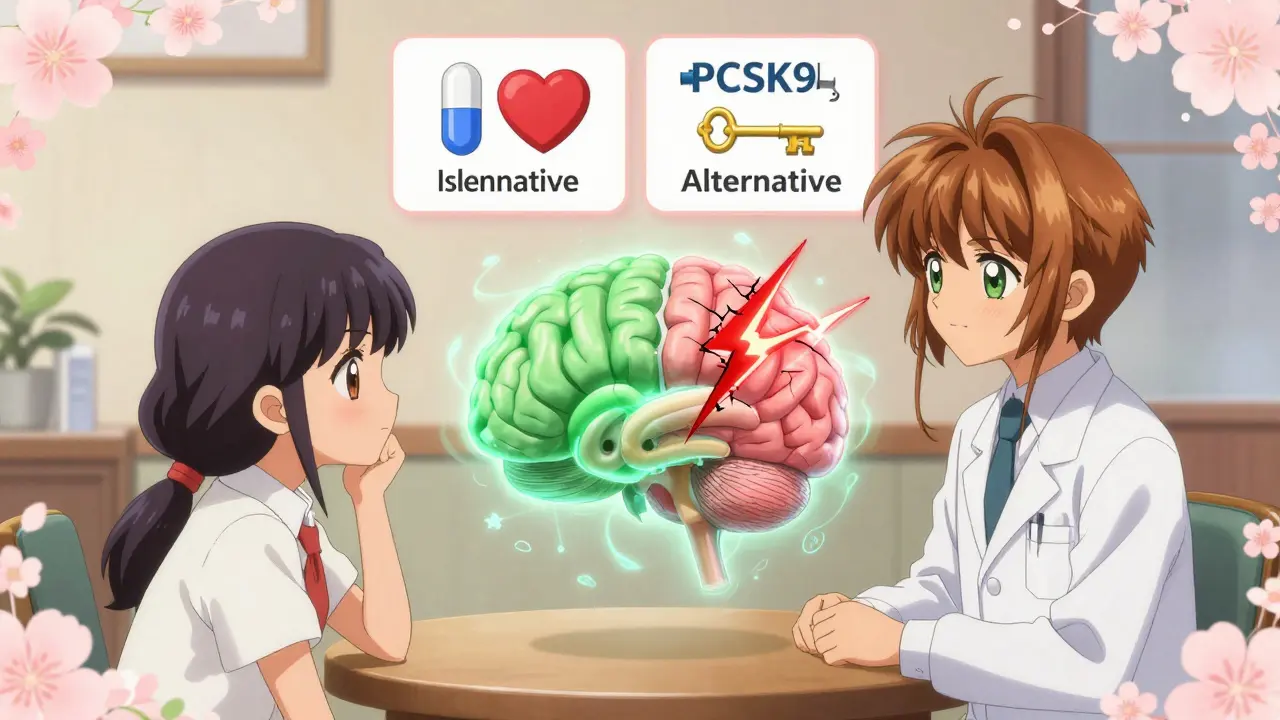
Another big development? PCSK9 inhibitors a newer class of injectable cholesterol-lowering drugs that do not increase hemorrhagic stroke risk. These drugs, like evolocumab and alirocumab, lower LDL even more than statins - up to 60% to 70%. And crucially, they don’t raise the risk of brain bleeds. The problem? They cost $10,000 a year. Most insurers won’t cover them unless you’ve tried statins and failed. But for people with a history of hemorrhagic stroke, they’re becoming the go-to alternative.
And there’s more on the horizon. The STROKE-STATIN trial an ongoing clinical trial comparing immediate versus delayed intensive statin therapy after acute ischemic stroke is still enrolling patients. Results expected by late 2024 could change how soon after stroke we start these drugs.
What Should You Do?
If you’ve had a stroke, here’s the practical advice:
- Don’t assume you need atorvastatin 80 mg. Ask if a lower dose might work.
- If you have muscle pain, don’t quit cold turkey. Ask about switching to rosuvastatin or intermittent dosing.
- If you’ve had a brain bleed before, statins may not be right for you - talk to a neurologist.
- Get liver and muscle enzyme tests before and during therapy.
- Make sure your doctor knows all your other meds - especially blood pressure pills.
- If cost is an issue, generic atorvastatin 40 mg is still effective and safer than simvastatin 80 mg.
The bottom line? Statins after stroke save lives - but only if you stay on them. And if side effects make you want to quit, there are options. The goal isn’t to be perfect. It’s to stay alive. A lower dose, a different statin, or even a PCSK9 inhibitor later - those are all better than stopping completely.
Are high-dose statins safe after a stroke?
High-dose statins like atorvastatin 80 mg are generally safe for most people after an ischemic stroke, but they carry increased risks of muscle pain, liver enzyme changes, and a small rise in hemorrhagic stroke. The benefits usually outweigh the risks for people with atherosclerotic stroke, but they’re not recommended for those with a history of brain bleeds. Always discuss your personal risk factors with your doctor.
What’s the difference between high-dose and moderate-dose statins after stroke?
High-dose statins (like atorvastatin 80 mg) lower LDL cholesterol by 45-60%, while moderate doses (like 10-20 mg) drop it by 25-40%. In the SPARCL trial, high-dose statins reduced recurrent stroke by 16%, but also increased brain bleed risk slightly. Moderate doses offer less protection but come with fewer side effects. The key is finding the lowest effective dose that you can tolerate.
Can I stop taking statins if I feel fine after a stroke?
No. Even if you feel fine, your arteries are still at risk. Studies show people who stop statins within six months of a stroke have a 42% higher chance of having another one. Side effects don’t mean you should quit - they mean you should talk to your doctor about lowering the dose or switching statins.
Do statins increase the risk of another brain bleed?
Yes, high-dose statins slightly increase the risk of hemorrhagic stroke - from 1.4% to 2.3% in the SPARCL trial. This risk is higher in people with prior brain bleeds, uncontrolled high blood pressure, or certain genetic factors. If you’ve had a hemorrhagic stroke, statins are usually avoided. For ischemic stroke survivors, the benefit of preventing another clot usually outweighs this small risk.
What are alternatives to high-dose statins after stroke?
If you can’t tolerate high-dose statins, alternatives include lower-dose statins, switching to rosuvastatin (often better tolerated), or adding ezetimibe to reduce cholesterol further. For those with high risk of brain bleeds or who’ve failed statins, PCSK9 inhibitors like evolocumab are an option - though they’re expensive and require injections. Lifestyle changes like diet and exercise help, but aren’t enough on their own after stroke.
What Comes Next?
Statin therapy after stroke isn’t a one-size-fits-all fix. It’s a balancing act - between preventing another clot and avoiding a bleed, between taking a pill every day and managing side effects. The best outcome isn’t always the highest dose. It’s the one you can stick with.
Keep in mind: if you’ve had a stroke, your body is still healing. Your arteries are still vulnerable. A statin - even at half the dose - is still better than none. Talk to your doctor, ask questions, and don’t give up on treatment just because it feels uncomfortable. The right dose, the right drug, and the right support can make all the difference.
Daniel Dover
Statins after stroke? I took 40mg atorvastatin for two years. Muscle soreness? Yeah. But I didn’t have another stroke. Worth it.
Low dose works. No need to go full 80mg unless your doc says so.
Chiruvella Pardha Krishna
The human body is not a machine to be optimized with pharmaceutical levers. Statins reduce LDL, yes-but life is not measured in cholesterol numbers alone. There is a quiet dignity in accepting vulnerability, in recognizing that not every threat can be silenced by a pill.
Perhaps the true stroke prevention lies not in pharmacology, but in stillness-in the refusal to rush back into the chaos that caused the rupture in the first place.
Virginia Kimball
OMG YES. I’m a stroke survivor and I switched from 80mg to 20mg rosuvastatin after my legs turned into concrete. My doc was like ‘cool, let’s try this’ and now I feel like a human again.
Also, I started walking 30 mins a day. Not because it’s ‘healthy’-because I missed dancing. Turns out, moving your body is kinda healing. Who knew?
Statins are tools, not magic. And you’re allowed to tweak the recipe.
Kapil Verma
Western medicine is a scam. In India, we treat stroke with turmeric, yoga, and fasting. Why are we poisoning ourselves with synthetic chemicals? 80mg statins? That’s not medicine-it’s corporate greed disguised as science.
My uncle had three strokes. He never took a statin. He’s alive at 82. You think your pill is saving you? It’s just keeping the pharmacy rich.
Michael Page
It’s interesting how we frame statin use as a binary choice-take it or don’t. But the real question is: at what point does intervention become overreach?
The SPARCL trial’s 16% reduction sounds compelling, but it’s a population-level statistic. For the individual, the risk-benefit calculus is far more nuanced. Especially when the side effects are tangible-muscle pain, fatigue, cognitive fog-and the recurrence benefit is probabilistic, delayed, and invisible.
Perhaps we need to stop treating patients like data points and start treating them like people.
Mandeep Singh
Let me tell you something. I’ve been a neurologist for 27 years and I’ve seen 1,400 stroke patients. Most of them quit statins because they’re lazy. ‘I feel fine’-yeah, because you’re not dead yet. But your arteries? They’re ticking like a bomb. You think you’re being smart by skipping pills? You’re just buying time to die slower.
And don’t even get me started on ‘natural remedies.’ Turmeric doesn’t lower LDL. It’s a spice. Not a drug. Get real.
Also, simvastatin 80mg? That’s a death sentence waiting to happen. I’ve seen rhabdo cases from that nonsense. Insurers push it because it’s cheap. Doctors know better. You don’t get to gamble with your brain.
Josiah Demara
Let’s cut the fluff. The SPARCL trial showed a 64% increase in hemorrhagic stroke risk. That’s not ‘slight.’ That’s a red flag screaming from the data.
And yet, every cardiologist still pushes 80mg like it’s gospel. Why? Because they’re trained to treat numbers, not people.
Also, PCSK9 inhibitors? $10k a year? That’s not medicine. That’s a luxury tax for the rich. Meanwhile, poor people are stuck with 80mg atorvastatin and praying they don’t turn into a pile of mush.
Healthcare isn’t broken. It’s designed this way.
Kaye Alcaraz
You’re not alone. I was told to take 80mg after my stroke. I couldn’t lift my coffee cup. My doctor said, ‘Try 40.’ I did. I still feel strong. I still take it. I still live.
It’s not about perfection. It’s about persistence. One pill. One day. One step.
You’ve got this.
Sarah Barrett
Interesting how the narrative around statins shifts from ‘life-saving’ to ‘risky’ depending on who’s speaking. The science is clear: for atherosclerotic stroke survivors, the benefit outweighs the risk. But the human experience? That’s where the real conversation begins.
It’s not about taking the highest dose. It’s about finding the dose that lets you live.
And if you’re struggling? Talk to someone. Not the internet. Not a random Reddit comment. A real person. A doctor. A pharmacist. Someone who sees you, not just your LDL.