

When you take a pill for high blood pressure or cholesterol, you expect every tablet to be identical. That’s because small-molecule drugs are made in labs using chemical reactions - like baking a cake from a recipe. Mix the same ingredients in the same order, and you get the same result every time. But biologic drugs? They’re not made that way. They’re grown. In living cells. And that changes everything.
What Makes Biologics Different?
Biologic drugs are made from living organisms - bacteria, yeast, or mammalian cells engineered to produce proteins that treat diseases like rheumatoid arthritis, cancer, and Type 2 diabetes. Think of Humira for joint pain or Ozempic for weight and blood sugar control. These aren’t chemicals. They’re massive, intricate molecules - up to 1,000 times bigger than a typical pill’s active ingredient. And because they’re alive, they’re never perfectly the same from batch to batch.The FDA says this variation is natural. You can’t control every tiny change in a living cell. Temperature shifts, nutrient levels, even tiny vibrations in the bioreactor can alter the final product. That’s why no two batches of a biologic are truly identical. And that’s why you can’t make an exact copy.
How Are Biologics Actually Made?
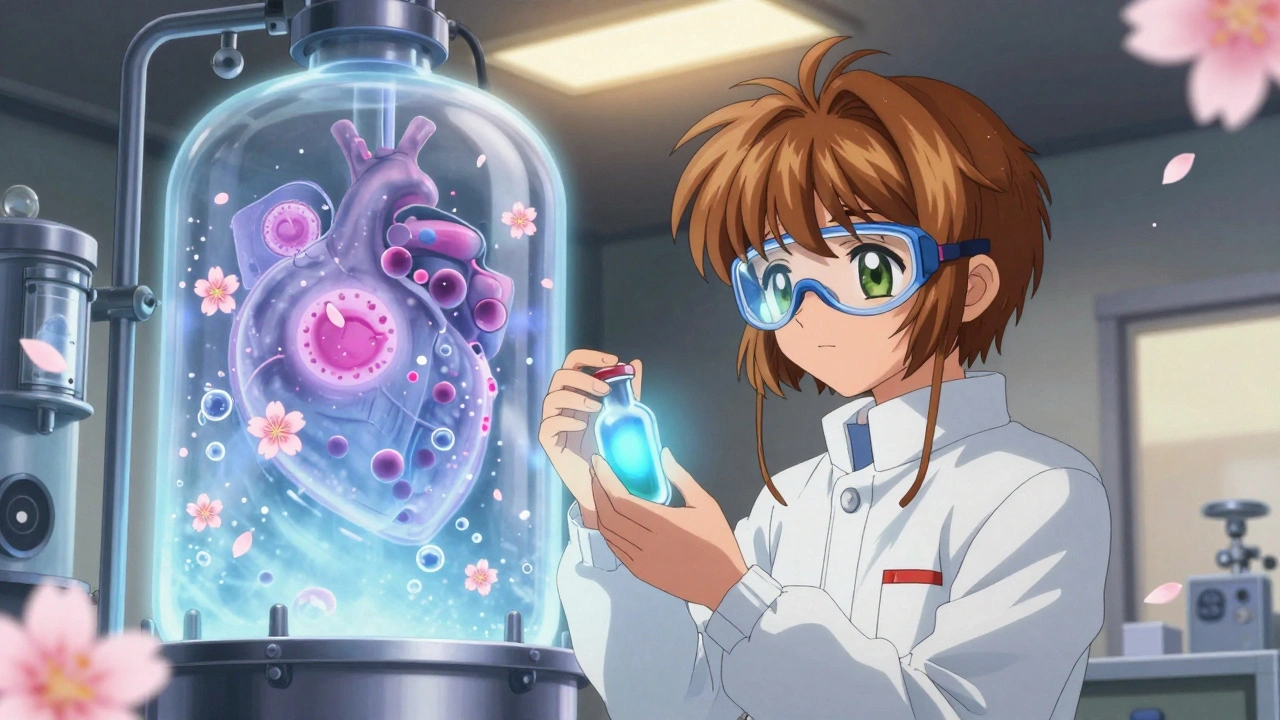
Making a biologic isn’t like mixing powder in a vat. It’s a 3-to-6-month journey with more than 100 steps. It starts with genetically modifying a cell so it becomes a protein factory. That cell line is then grown in huge stainless-steel tanks called bioreactors, filled with nutrient-rich broth, kept at 37°C - body temperature - and monitored constantly. If the pH drops by 0.1 unit or oxygen levels dip, the cells can die or produce the wrong protein shape. One small mistake, and the whole batch - worth half a million dollars - is trash.After the cells grow for 10 to 14 days, the protein is pulled out. That’s the downstream process: filtering, purifying, removing viruses, and removing leftover cell debris. One key step uses Protein A chromatography - a fancy filter that grabs only the right protein. Even then, purity hits 95-98%. The rest? Impurities that can’t be fully removed because we don’t even know what all of them are.
Then comes formulation - adding buffers, stabilizers, and preservatives to keep the protein from falling apart. Finally, it’s filled into vials or pens. Each step requires sterile conditions (ISO Class 5 cleanrooms), constant testing, and thousands of pages of documentation per batch. One company told me they keep 12,000 pages of records for a single biologic product. That’s not bureaucracy - it’s survival.
Why Can’t You Just Copy Them Like Generics?
Generics are copies of small-molecule drugs. If the original drug is aspirin, a generic is just aspirin made by a different company. The molecule is simple. Chemists can break it down, analyze every atom, and rebuild it exactly. The FDA approves generics based on bioequivalence - does it work the same in your body? Yes? Approved.But with biologics, you can’t reverse-engineer the molecule. You don’t know all the structural details. Even if you could, the manufacturing process is part of the drug. The cell line. The bioreactor type. The temperature curve. The purification method. All of it shapes the final product. Two companies using the same cell line but different filters or water systems will make different proteins.
That’s why the FDA doesn’t allow “generic biologics.” Instead, they have biosimilars - drugs that are highly similar, but not identical. To get approval, a biosimilar must undergo over 100 analytical tests, animal studies, and sometimes clinical trials to prove it works the same way. It’s not a copy. It’s a very close cousin.
What Happens When Manufacturing Goes Wrong?
In 2022, a survey of 158 biopharma facilities found that contamination was the #1 cause of batch failure - 35% of all losses. One Reddit user, a process engineer, described losing a $700,000 batch because a single valve leaked and introduced a trace of cleaning agent. The cells didn’t die - they just started making a slightly different protein. The product was safe, but it didn’t meet specs. It was destroyed.Another engineer on LinkedIn shared that scaling from a 2,000-liter bioreactor to 15,000 liters took 17 months and cost $22 million in lost revenue. Why? Because the way cells behave in a small tank doesn’t predict how they’ll act in a huge one. You can’t just scale up. You have to relearn the whole process.
Even with advanced tech like real-time sensors and AI-driven controls, the industry still struggles. One expert said current tools can only analyze 60-70% of a monoclonal antibody’s structure. That means 30-40% of the molecule? We’re flying blind. And that’s why regulators demand so much testing.
Biosimilars: The Only Real Alternative
Biosimilars are the answer to the “no exact copies” problem. They’re not cheaper copies - they’re expensive, complex products in their own right. The first biosimilar to Humira hit the market in 2023. It took 10 years of R&D and $200 million to develop. The company had to prove it worked like the original in over 1,000 patients.Today, the global biosimilars market is worth $10.5 billion. By 2028, it’s expected to hit $30 billion. But don’t expect them to slash prices like generics did. Because making a biosimilar costs 10 times more than making a generic pill. And the manufacturing risk? Just as high.
Some experts argue the FDA is too strict - that minor differences don’t affect patients. But regulators aren’t taking chances. One wrong shape in a protein could trigger an immune reaction. That’s not theoretical. It’s happened before. In the 1990s, a contaminated biologic caused a rare blood disorder in hundreds of patients. That’s why the bar stays high.
The Future: Faster, Smarter, But Still Complex
New tech is helping. Single-use bioreactors cut contamination risk by 60%. Continuous manufacturing - where the process runs nonstop instead of in batches - is being tested in 15% of new plants. AI is predicting how changes in temperature or nutrient flow will affect protein quality. Some companies are even using machine learning to design better cell lines.But the core truth won’t change: biologics are made by living systems. And living systems are messy. They adapt. They drift. They surprise you. No matter how advanced the tech gets, you’ll never be able to make an exact copy.
That’s not a flaw. It’s a feature. It’s why biologics can treat diseases that pills never could. But it also means they’ll always be expensive, complex, and hard to replicate. The next time you hear someone say “why don’t we just make a cheaper version?” - now you know. It’s not about patents. It’s about biology.
Can biosimilars be substituted for the original biologic drug without a doctor’s approval?
No. In the U.S., biosimilars are not automatically interchangeable with the original biologic unless they receive an "interchangeable" designation from the FDA. Even then, state laws vary - some require pharmacists to notify the prescriber before switching. Always check with your doctor or pharmacist before switching.
Why are biologic drugs so expensive if they’re just proteins?
It’s not the protein - it’s the process. Making a biologic takes months, requires sterile cleanrooms, thousands of quality tests, and specialized equipment costing millions. A single batch can cost $500,000 to produce. If 10% of batches fail, that cost gets spread across the ones that pass. Add in R&D, regulatory fees, and 10+ years of development, and the price makes sense - even if it’s painful to pay.
Are biosimilars as safe as the original biologic?
Yes. Every biosimilar approved by the FDA has been shown to have no clinically meaningful differences in safety, purity, or potency compared to the original. They undergo the same rigorous testing as the brand-name drug - often more. Millions of doses have been given worldwide with no new safety signals.
Do biologics work better than traditional pills?
Not always - but for certain diseases, they’re the only option. Small-molecule drugs can’t target specific immune proteins or cancer cells with precision. Biologics can. For rheumatoid arthritis, Crohn’s disease, or certain cancers, they’ve transformed survival rates and quality of life. But for high blood pressure or cholesterol? Pills still work better and cost less.
Why aren’t there more biosimilars on the market?
Because it’s incredibly hard and expensive. Developing a biosimilar takes 8-12 years and costs $100-$200 million. Many companies can’t afford the risk. Plus, brand-name manufacturers often extend patents or create complex delivery systems to delay competition. It’s not just science - it’s business.
Arjun Deva
Of course they can't be copied! The FDA, Big Pharma, and the WHO are all in on it - they're hiding the fact that biologics are just genetically modified soy protein with a side of lithium and fluoride to keep you docile. You think they want you healthy? No - they want you dependent. That $200M biosimilar? That's just a tax on your suffering. And don't get me started on the cleanrooms... those aren't sterile - they're surveillance hubs. Every bioreactor has a camera. They're watching your cells. They're watching YOU.
Inna Borovik
While the article presents a technically accurate overview of biologics manufacturing, it fails to address the systemic inefficiencies in regulatory capture. The FDA’s biosimilar approval framework is structurally biased toward incumbent manufacturers through excessive analytical requirements that are not clinically validated. The 100+ tests are not scientific rigor - they're rent-seeking. The cost differential between generics and biosimilars is not a function of biological complexity, but of regulatory arbitrage designed to preserve monopoly pricing. The industry's narrative of 'biological variability' is a smokescreen for profit retention.
Jackie Petersen
Let me get this straight - we’re spending billions to grow protein in tanks because we can’t just synthesize it like aspirin? That’s insane. We’ve got robots that can assemble iPhones in minutes. Why can’t we build a protein like a Lego set? This is American innovation? We’re out here fighting over who gets to use the same bioreactor. Meanwhile, China’s making biosimilars in 3 years for 1/10th the cost. We’re not behind - we’re lazy. And the FDA? They’re just scared of change. If you can’t copy it, you’re not trying hard enough.
Annie Gardiner
What if the real problem isn’t biology… but our obsession with control? We want everything to be identical - pills, babies, relationships. But life doesn’t work like that. A biologic isn’t a drug - it’s a living conversation between a cell and its environment. Every batch is a poem written in amino acids. Maybe we’re not meant to copy it. Maybe we’re meant to learn to accept variation - in medicine, in people, in everything. The fear of difference is what’s expensive. Not the protein. Not the tanks. The fear.
Rashmi Gupta
They say you can't reverse-engineer biologics. But what if we just stopped trying? What if we stopped acting like every molecule has to be perfect? In India, we’ve been making affordable biologics for years - not by copying, but by adapting. We don’t need ISO Class 5 cleanrooms to save lives. We need ingenuity. And maybe… just maybe… the West’s obsession with precision is what’s killing accessibility. A 95% pure protein that saves a child is better than a 99.9% pure one that costs $100,000 and sits on a shelf.
Karen Mitchell
It is imperative to recognize that the assertion that biologics cannot be replicated is not merely a scientific claim - it is an ethical imperative. The potential for immunogenicity, even from minute structural deviations, represents an unacceptable risk to public health. The precedent set by the 1990s contamination event - which resulted in irreversible neurological damage - remains a sobering reminder that regulatory leniency is not innovation; it is negligence. Therefore, the current framework, while costly, is not excessive - it is morally non-negotiable.
Geraldine Trainer-Cooper
Living cells make messy stuff. That’s why they work. Stop trying to turn biology into a spreadsheet.
Kenny Pakade
Let’s be real - this isn’t about science. It’s about American supremacy. We built this industry. We own the patents. We control the tech. And now we’re using ‘biological complexity’ as an excuse to keep the rest of the world out. China’s got CRISPR labs in every province. India’s got biosimilar factories running 24/7. But we? We’re still crying about 0.1 pH shifts like it’s the end of the world. We’re not protecting patients - we’re protecting our dominance. And it’s pathetic.
Katie O'Connell
One must consider the ontological implications of biologics as emergent phenomena - they are not merely molecular entities, but dynamic systems embedded within socio-technical ecologies. The notion of ‘copying’ presumes a reductive materialism that fails to account for the epistemic uncertainty inherent in cellular autopoiesis. To demand identicality is to impose a mechanistic paradigm upon a phenomenological process - a category error of monumental proportions. The biosimilar is not a substitute; it is a heterotopia - a mirror that reflects, but never replicates, the original.
Gwyneth Agnes
They’re expensive because they’re over-engineered. Cut the bureaucracy. Cut the cleanrooms. Cut the 12,000 pages. Let people use good enough.
Kay Jolie
Think of biologics as jazz improvisation. The original is Coltrane - perfect, unpredictable, alive. A biosimilar? It’s a brilliant young musician in Tokyo who studied every note, every breath, every silence - but still, it’s not Coltrane. It’s not supposed to be. It’s a tribute. A masterpiece in its own right. And yet… we still pay $200K for the original because we worship the myth of the genius. We don’t want the cover. We want the legend. And that’s not biology - that’s culture. That’s capitalism. That’s us.