
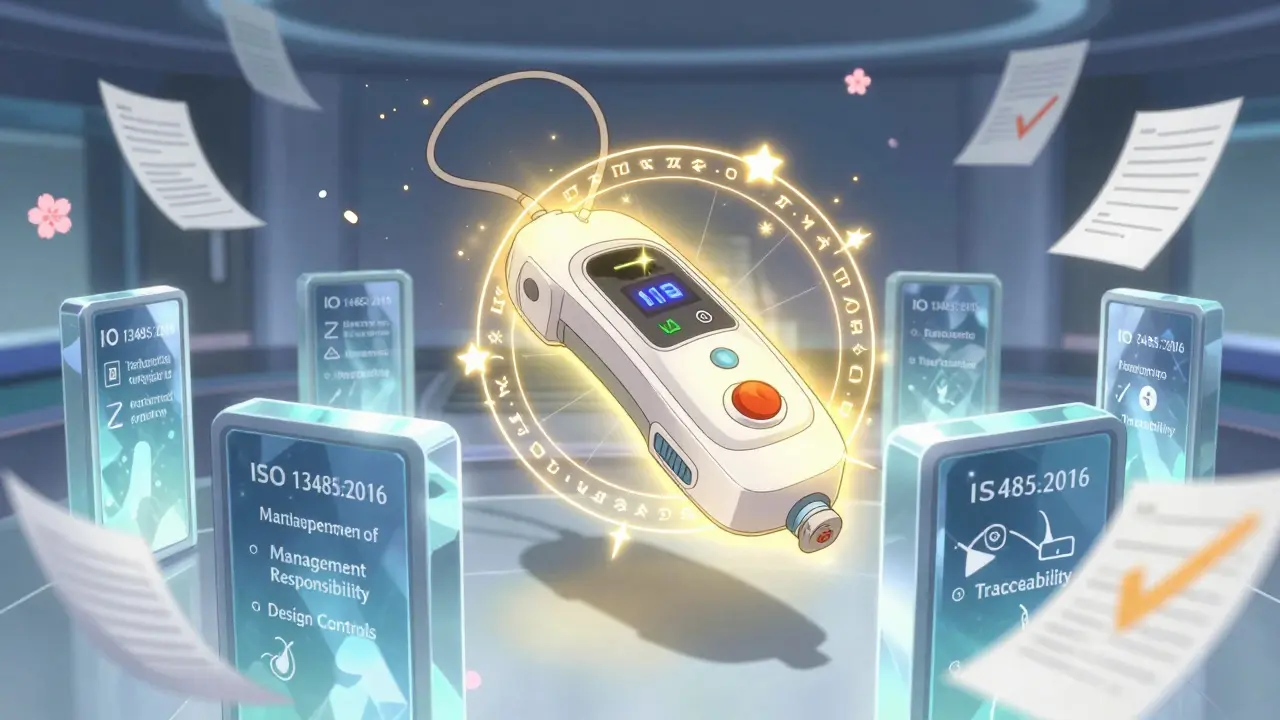
When a patient receives a pacemaker, an insulin pump, or a surgical instrument, they shouldn’t have to wonder if it’s safe. That trust isn’t accidental. It’s built by quality control in manufacturing - a quiet, relentless system of checks, tests, and documentation that stands between flawed devices and human lives. In 2026, this system has changed more in the last two years than it has in the past decade. And for anyone who relies on medical devices, that change matters.
What’s Really at Stake?
Every year, millions of medical devices are made: ventilators, catheters, glucose monitors, joint replacements. A single defect can mean infection, malfunction, or death. The FDA estimates that without strict quality controls, about 30% of device failures would reach patients. That’s not a guess - it’s based on years of tracking recalls and adverse event reports. And it’s why quality control isn’t just about meeting standards. It’s about preventing harm before it happens.
Think about it this way: if a smartphone battery explodes, it’s a nuisance. If a heart monitor fails, it’s a life-or-death situation. That’s why the rules for medical devices aren’t like other products. They’re stricter, more detailed, and constantly evolving. And right now, they’re being rewritten - for the first time since 1996.
The Big Shift: ISO 13485:2016 Is Now the Law
Until recently, U.S. manufacturers followed two sets of rules. One was the FDA’s 21 CFR Part 820 - a detailed list of requirements for how to run a quality system. The other was ISO 13485:2016, the global standard used by nearly every other country. Companies selling devices overseas had to do double the work: one system for the U.S., another for Europe, Canada, Australia. It was expensive. It was confusing. And it created gaps.
On January 31, 2024, the FDA made a historic move. It officially adopted ISO 13485:2016 as the new standard for medical device manufacturers in the United States. As of February 2, 2026, every company making devices here must comply with this single, globally recognized system. That’s not a suggestion. It’s a legal requirement.
This change isn’t just paperwork. It means:
- Manufacturers no longer need duplicate documentation for U.S. and international markets.
- Supply chains can be managed under one consistent framework.
- Inspections by the FDA now align with global audit practices.
For companies, this cuts compliance costs by up to 30%. For patients, it means fewer inconsistencies, fewer delays, and more reliable devices.
The Core of the System: 11 Critical Subsystems
ISO 13485:2016 doesn’t just say “be careful.” It lays out exact requirements. The FDA’s old regulation listed 11 subsystems that every quality system must include. The new one keeps them - but ties them tighter to risk management.
Here’s what’s non-negotiable:
- Management Responsibility - Leaders must actively support quality. Not just approve budgets, but attend reviews, answer audit questions, and fix root causes.
- Design Controls - Every device design must be tested, documented, and traceable. If you change a material, you must prove it won’t affect safety.
- Document Control - Every SOP, form, and instruction must be versioned, approved, and accessible. No sticky notes on machines.
- Purchasing Controls - Suppliers aren’t just vendors. They’re part of your quality system. You must audit them. Track their performance. And document every change.
- Production and Process Controls - Machines aren’t set and forget. You must monitor variables like temperature, pressure, and speed. Statistical Process Control (SPC) is required for critical steps.
- Identification and Traceability - If a device fails, you must know exactly which batch it came from, which parts were used, and who inspected it. That’s not optional. It’s life-saving.
- Acceptance Activities - Every product must be tested before it leaves the factory. No exceptions.
- Nonconforming Product - If something fails, it must be quarantined, investigated, and corrected - not just thrown away.
- Corrective and Preventive Action (CAPA) - If a defect happens once, you must fix the system so it never happens again.
- Quality Audits - Internal audits must happen at least once a year. External audits by certified bodies? That’s mandatory under ISO 13485.
These aren’t suggestions. They’re the backbone of patient safety.

Real-World Testing: What Gets Checked?
It’s not enough to have paperwork. Devices must be tested under real conditions. For example:
- Electrical devices must pass a 1,500-volt dielectric strength test to ensure no current leaks through insulation.
- Leakage current must stay under 100 microamperes during normal use - less than the shock you’d feel from a static zap.
- Implantable devices undergo accelerated aging tests to simulate 10+ years of use in just weeks.
- Software-driven devices (like AI-powered diagnostic tools) must prove their algorithms don’t change unpredictably over time.
These aren’t theoretical. A 2022 study by AAMI showed that manufacturers with mature quality systems had a 99.97% first-pass yield - meaning almost every device passed inspection the first time. Facilities with weak systems? Only 98.2%. That difference isn’t small. It’s 17 times more defects.
The Hidden Danger: Paper Quality Systems
Here’s the scary part: some companies have perfect documentation - and still fail patients.
Dr. Marc Jacobi, a former FDA quality reviewer, called this “paper quality systems.” These are companies that fill binders with procedures but don’t train staff. They don’t fix root causes. They just check boxes.
And it’s common. In 2023, 23% of FDA inspection findings were about “inadequate process validation” - even when all the paperwork was complete. One company had 12 pages of SOPs for sterilizing a catheter. But their workers never followed them. The result? A batch of contaminated devices reached hospitals.
True quality isn’t about having a file. It’s about having people who understand why the rules exist.
How Manufacturers Are Adapting
Some companies are thriving. One manufacturer using Greenlight Guru’s QMS software reported a 32% higher audit success rate. Another cut corrective action time from 45 days to 17 after implementing ISO 13485:2016.
But it’s not easy. The transition took most companies 18-24 months. Training alone required 200-400 hours per employee. Legacy machines built before 2010 often can’t connect to modern digital quality systems. Fifty-seven percent of manufacturers struggled with that.
And the paperwork? It’s still heavy. In a 2023 survey of 212 quality managers, 68% said they spent more time on documentation than on improving processes. That’s a problem - because quality isn’t about filling forms. It’s about preventing failures.
What’s Next? AI, Cybersecurity, and the Future
Quality control is getting smarter. Early adopters are using machine learning to predict defects before they happen. One company reduced defects by 38% by analyzing vibration patterns in assembly robots.
By 2027, Gartner predicts 60% of medical device manufacturers will use AI-driven analytics. That’s not science fiction. It’s already happening.
But the next big challenge is cybersecurity. Software in medical devices - from insulin pumps to MRI machines - is now a major risk. The next version of ISO 13485 (expected in 2025) will include new rules for securing software. Because a hacked device isn’t just a malfunction. It’s a weapon.
Meanwhile, the global market for quality management software is growing fast. It was worth $1.27 billion in 2023. By 2028, it’s projected to hit $2.84 billion. Why? Because regulators aren’t slowing down. They’re getting smarter. And so are the systems that protect patients.
Why This All Matters
At the end of the day, quality control in manufacturing isn’t about compliance. It’s about care. Every test, every audit, every traceable serial number - it’s all there because someone, somewhere, could die if it’s not done right.
The FDA says robust quality systems prevent about 200,000 adverse events every year. That’s not a number. That’s 200,000 people who didn’t get infected. Didn’t have a stroke. Didn’t suffer because a device failed.
And now, with ISO 13485:2016 as the law, the system is clearer, more consistent, and more powerful than ever. The goal hasn’t changed: make sure every device works - every time. But the way we get there? That’s evolving. And for patients, that’s everything.
What is ISO 13485:2016 and why does it matter for medical devices?
ISO 13485:2016 is the international standard for quality management systems in medical device manufacturing. It requires companies to control every step of design, production, and testing to ensure safety and effectiveness. Since February 2, 2026, it’s the mandatory standard in the U.S., replacing the old FDA QSR. This means global consistency - fewer redundant checks, faster approvals, and stronger patient protection.
How does the FDA now enforce quality control?
The FDA enforces ISO 13485:2016 through inspections, audits, and warning letters. Manufacturers must demonstrate compliance with all 11 subsystems, including design controls, CAPA, and supplier oversight. Inspections are risk-based but occur more frequently than before - averaging 5.2 days per visit with over 7 nonconformities found per inspection. Noncompliance can lead to product seizures, import bans, or criminal charges.
What happens if a medical device fails quality control?
If a device fails testing or inspection, it’s quarantined immediately. The company must investigate why, fix the root cause, and document the solution under Corrective and Preventive Action (CAPA). If the issue affects devices already shipped, a recall may be issued. Class I recalls - the most serious - are for devices that could cause serious injury or death. The FDA tracks every recall publicly.
Are all medical devices subject to the same quality standards?
No. Devices are classified into Class I (low risk, like tongue depressors), Class II (moderate risk, like infusion pumps), and Class III (high risk, like pacemakers). Higher classes require more rigorous controls, including clinical data and premarket approval. But all classes must follow ISO 13485:2016. The difference is in the depth of testing and documentation, not the standard itself.
Can small manufacturers afford to comply?
Yes, but it’s harder. The FDA offers guidance documents and free training resources. Many small firms use cloud-based QMS software like Greenlight Guru, which cuts implementation costs by 40%. However, companies under 50 employees still struggle with staffing and training. Without support, they risk delays in market access or noncompliance penalties. The harmonized standard helps - but doesn’t eliminate the burden.
What’s the biggest mistake manufacturers make in quality control?
The biggest mistake is treating quality as a paperwork exercise. Companies that focus on filling forms instead of understanding processes end up with “paper quality systems.” These fail during real production issues. The FDA finds these gaps in 23% of inspections. True quality means training people, listening to frontline workers, and fixing problems at the source - not just documenting them.
Mayank Dobhal
This is wild. I work in a factory in Bangalore and we just switched to ISO 13485 last year. No more double paperwork. My team actually has time to breathe now. And yeah, we caught a bad batch before it shipped because someone noticed a weird vibration in the autoclave. Not because of a form. Because we were paying attention.
Marcus Jackson
The FDA adopting ISO 13485 was inevitable. The old QSR was a relic. But let’s be real - most manufacturers still treat it like a checklist. The real win is when engineers start asking 'why' instead of 'what do I need to document'.
Natasha Bhala
i just wanna say thank you to everyone who works in qc. seriously. no one talks about you but you’re the reason my mom’s pacemaker didn’t fail. you’re the quiet heroes.
love you all <3
Jesse Lord
paper quality systems are the worst. i’ve seen it. teams with 100 pages of SOPs but no one knows what the hell they’re doing. training isn’t a box to check. it’s the whole damn game.
if you’re not listening to the line workers, you’re not doing quality. you’re doing paperwork.
AMIT JINDAL
Let me drop some truth bombs here. Most U.S. manufacturers are still stuck in 2010 thinking. ISO 13485:2016 isn’t just a standard - it’s a philosophical shift. You need to embrace risk-based thinking, not just compliance. And if you’re using Excel spreadsheets for CAPA? You’re already dead.
I’ve consulted for 12 medtech firms. Only 2 had real culture. The rest? Paper palaces. And guess who gets audited first? The ones with perfect docs but zero real control. 😏
Catherine Wybourne
I’m British and we’ve been on ISO 13485 since 2017. Honestly? The U.S. was dragging its feet. But now that it’s here, it’s beautiful. Global alignment = fewer delays = faster access to life-saving tech.
Still… I chuckle at the phrase 'no sticky notes on machines'. As if anyone in a UK lab would dare. We’ve got enough paperwork without adding sticky notes to the chaos. 😅
Ashley Hutchins
people who think this is about 'patient safety' are delusional. this is all about cost-cutting. the FDA didn’t switch to ISO because they care - they did it because it’s cheaper for them to audit one system.
and don’t get me started on AI. you think an algorithm can catch a human error? please. the real problem is lazy managers who think software fixes culture. it doesn’t. people do. and most of them are still asleep at the wheel.
Lakisha Sarbah
i work in a small shop in ohio. we make surgical clamps. we’re 14 people. we didn’t have a QMS software until last year. now we’re compliant. no one’s screaming. no one’s quitting. we just… did it.
turns out, when you treat people like humans not robots, they care. and that’s the real quality system.
Mary Carroll Allen
OK BUT. The 99.97% first-pass yield stat? That’s the most powerful thing in this whole post. That’s not luck. That’s discipline. That’s every single person in the factory showing up, knowing why they’re there.
I used to work in pharma. We had a guy who’d stare at the temperature log for 20 minutes before every shift. Said he 'felt' the machine. We didn’t have AI. We had him. And he saved lives.
Technology helps. But the soul of QC? That’s human. Always.
Tola Adedipe
You think AI is the future? Nah. The real innovation is giving frontline workers the power to stop the line. No approval. No form. Just say 'stop' and the whole production halts. That’s real quality.
We did it in Montreal. 18 months later, our defect rate dropped 73%. No software. Just trust.
If your QMS doesn’t empower the person holding the wrench, it’s a prison.
Eric Knobelspiesse
I’ve read this post 7 times. Let me philosophize.
Quality control isn’t about preventing defects. It’s about confronting our fear of imperfection. Every device that passes is a tiny act of hope. A belief that someone out there won’t die because we were careless.
The FDA didn’t adopt ISO 13485 to save lives. They adopted it because we finally stopped pretending we could outsource morality to a checklist.
We’re not machines. We’re fragile. And that’s why we need systems so damn hard.
It’s not about compliance. It’s about mourning the people we almost lost. And vowing - not promising - never again.