

When you pick up a prescription, you might not think twice about whether it’s extended-release or immediate-release. But that difference isn’t just about how often you take it-it can mean the difference between feeling stable all day or crashing by afternoon, between staying safe or risking an overdose. This isn’t a minor detail. It’s one of the most important things you should understand about your medication.
How Extended-Release and Immediate-Release Work
Immediate-release (IR) pills work fast. You swallow them, and within 15 to 30 minutes, your body starts absorbing the full dose. Peak levels hit in about an hour. That’s why IR painkillers or ADHD meds make you feel something quickly. But the effect doesn’t last. Most IR drugs wear off in 4 to 8 hours, meaning you need to take them multiple times a day.
Extended-release (ER), sometimes labeled XR, SR, or CR, is built differently. Instead of dumping all the drug into your system at once, it releases it slowly-over 12 to 24 hours. This keeps your blood levels steady. For example, bupropion ER keeps plasma concentrations between 100-200 ng/mL for a full day. The same drug in IR form spikes to 400-600 ng/mL in two hours, then drops below therapeutic levels. That spike isn’t just ineffective-it’s dangerous. At levels above 350 ng/mL, bupropion can trigger seizures. That’s why ER versions are designed to avoid those peaks.
ER drugs use clever tech: hydrophilic matrices (like the gel in Metformin XR), osmotic pumps (like Concerta’s inner mechanism), or layered tablets that release drug in stages. These aren’t just fancy coatings. They’re engineered systems. If you crush or split them, you’re breaking the system-and that can be deadly.
Why Timing Matters More Than You Think
Timing isn’t just about convenience. It’s about safety and effectiveness. Take Adderall: Adderall IR lasts 4 to 6 hours. That means if you’re a student or worker taking it for ADHD, you might need a second dose at lunch. But in school or office settings, that’s not always practical. Adderall XR delivers 10 to 12 hours of control with one dose. No midday trips to the nurse. No stigma. Just steady focus.
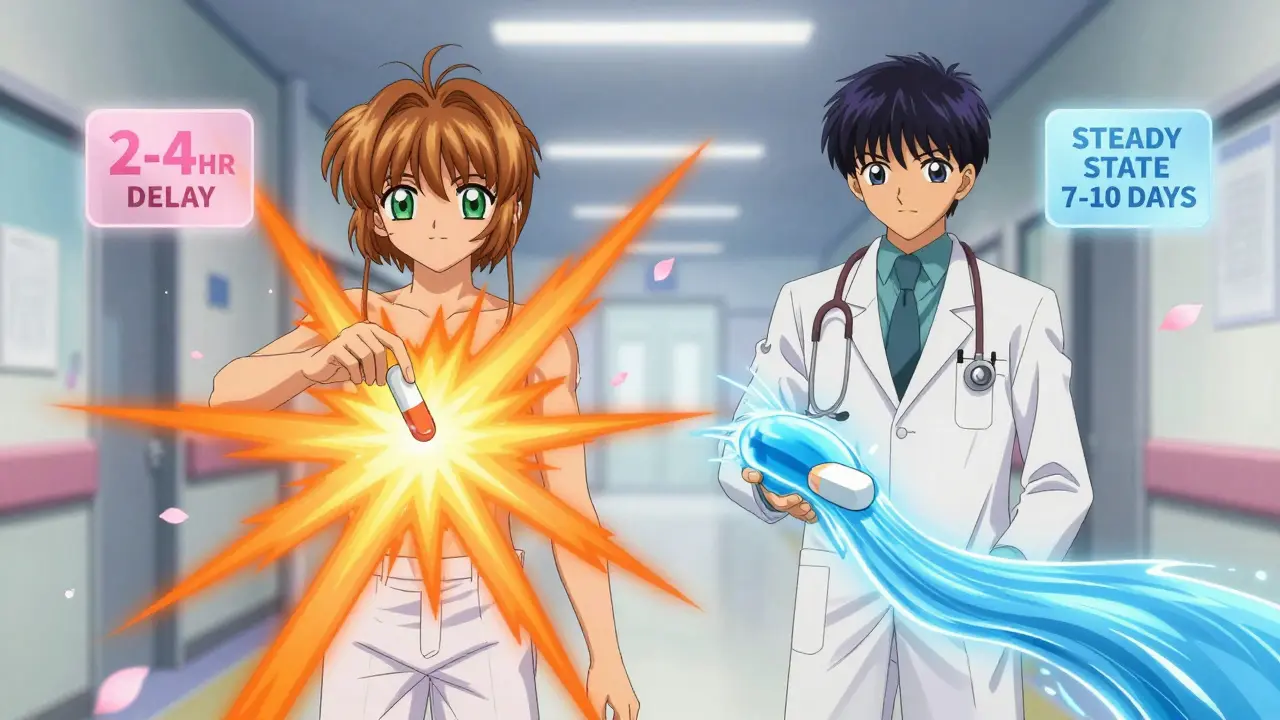
But here’s the catch: ER drugs don’t work right away. It takes 2 to 4 hours to reach therapeutic levels. That’s why so many people get frustrated. They take their ER medication, feel nothing after an hour, and think, “It’s not working.” So they take another pill. And that’s how overdoses happen. A 2022 GoodRx survey of 5,000 chronic medication users found that 41% initially struggled with this delay. Of those, 28% took extra doses-and 9% ended up with adverse events.
Doctors have to account for this, too. It takes 7 to 10 days for ER drugs to reach steady state in your body. IR drugs? Just 3 to 5 days. If you switch from IR to ER, you might not feel better for a full week. That’s normal. But if you’re not told that, you might assume your doctor got it wrong.
The Hidden Risks of Extended-Release
ER sounds safer because it’s gentler on your body. But it’s also riskier in emergencies. If you overdose on an IR pill, the drug is mostly absorbed within a few hours. ER? The drug keeps leaking out for 24 to 48 hours. That’s why hospital stays for extended-release bupropion overdoses are 2 to 3 times longer than for IR. The National Poison Data System reported this in 2021-and it’s not just about bupropion. The same applies to opioids, antidepressants, and even some heart medications.
And then there’s the physical form. Over 90% of ER tablets cannot be split, crushed, or chewed. The FDA issued a safety warning in 2020 specifically about extended-release opioids being crushed-leading to rapid, lethal release. Even if a tablet looks like it can be split (some have a score line), it doesn’t mean it’s safe. Venlafaxine XR, for example, has a non-scored tablet. Pharmacists report that 23% of medication errors with ER drugs come from people splitting them, thinking they’re saving money or adjusting dose.
Another hidden risk? Your stomach. If you have gastroparesis (delayed gastric emptying), ER drugs can absorb unpredictably. The FDA warned in July 2023 that patients with this condition can end up with 30-50% higher peak concentrations than healthy people. That means a dose that’s safe for most could overdose you.
When Immediate-Release Is the Better Choice
Just because ER is popular doesn’t mean it’s always best. Sometimes, IR is the only smart option.
Take pain management. If you’re dealing with breakthrough pain-a sudden flare-up between doses-ER opioids won’t help fast enough. It takes 2 to 4 hours for them to kick in. IR opioids? You get relief in 15 to 30 minutes. That’s why many pain patients are prescribed both: ER for baseline control, IR for emergencies.
Same goes for psychiatric care. When starting a new antidepressant or antipsychotic, doctors often begin with IR to fine-tune the dose. You need to see how your body reacts before locking into a slow-release system. Dr. Charles Parker from Alto Pharmacy puts it plainly: “Immediate-release remains essential for titration phases and acute symptom management.”
And let’s not forget cost. ER versions typically cost 15-25% more. Adderall XR runs $350-$450 for 30 capsules. Adderall IR? $280-$380. For people on tight budgets, that difference matters. If you don’t need the steady release-if your schedule allows for multiple doses-IR can be just as effective and far cheaper.
Real People, Real Experiences
Reddit threads tell stories you won’t find in medical journals. On r/ADHD, one user named PharmaGrad2020 said: “XR’s smooth ride prevents the 2pm crash I got with IR, but I keep 5mg IR tabs for when I need instant focus for presentations.” That’s the sweet spot: ER for daily stability, IR for spikes.
On Drugs.com, patients on metoprolol ER reported 32% fewer dizziness episodes than those on IR. But 27% said they felt useless during panic attacks because the ER version didn’t act fast enough. One woman wrote: “I took my ER beta-blocker at 8 a.m. My heart started racing at noon. I felt like I was going to pass out. I had to call 911.”
These aren’t outliers. They’re common. And they show that the best choice isn’t always one-size-fits-all. It depends on your life, your symptoms, and your body.
What You Should Do
- If you’re on ER: Don’t crush, split, or chew. Ever. Even if the pill looks like it’s meant to be split.
- Wait at least 2-4 hours before deciding your ER med isn’t working. Don’t double up.
- If you’re switching from IR to ER, give it 7-10 days to build up in your system.
- Keep IR on hand if you have conditions that need quick relief-like breakthrough pain or acute anxiety.
- Ask your pharmacist: “Is this tablet designed to be taken whole?” If they hesitate, ask for the manufacturer’s prescribing info.
- If you have digestive issues (gastroparesis, Crohn’s, recent gastric surgery), tell your doctor. ER meds might not be safe for you.
Market Trends and What’s Next
The global market for extended-release drugs hit $127 billion in 2022 and is growing fast. Antidepressants make up nearly a third of that. In the U.S., 68% of new antidepressant prescriptions are ER. That’s not because ER is perfect-it’s because adherence is better. A 2022 JAMA study of 15,000 hypertension patients found 78% of ER users took their meds consistently, compared to just 56% on IR.
But innovation is coming. New tech like Aversion®-used in some ADHD meds-makes pills turn into gel if crushed, deterring abuse. MIT researchers are even testing 3D-printed “polypills” that release different drugs at precise times. These could change how we treat multiple chronic conditions.
Still, the basics haven’t changed. ER isn’t better. IR isn’t worse. They’re tools. And like any tool, they work best when you understand how to use them.
Can I cut my extended-release pill in half to save money?
No. Over 90% of extended-release tablets are not designed to be split. Even if they have a score line, cutting them can destroy the slow-release mechanism. This can cause a sudden, dangerous flood of medication into your system. For example, splitting Venlafaxine XR or Concerta can lead to overdose. Always take ER pills whole. If cost is an issue, ask your doctor about switching to the immediate-release version or a generic.
Why don’t I feel my extended-release medication working after I take it?
Extended-release meds take 2 to 4 hours to start working-sometimes longer. That’s normal. It’s not a sign the drug isn’t working. It’s designed to release slowly. You might not feel anything for hours, but your blood levels are still building. If you take another dose because you don’t feel it, you risk overdose. Wait at least 4 hours before considering a second dose. And remember: it can take 7 to 10 days for the full effect to build up in your body.
Is extended-release always better than immediate-release?
No. While ER reduces dosing frequency and improves adherence, it’s not always better. Immediate-release is essential for situations that need fast action-like breakthrough pain, panic attacks, or when starting a new medication. Doctors often use IR to adjust doses before switching to ER. If you need quick relief or are on a tight budget, IR might be the smarter choice. The best option depends on your condition, lifestyle, and how your body responds.
What happens if I crush or chew an extended-release pill?
Crushing or chewing an extended-release pill can release the entire dose at once, leading to a dangerous spike in blood levels. This can cause overdose symptoms-seizures, heart palpitations, confusion, or even death. The FDA has issued multiple warnings about this, especially with opioids and ADHD medications. Even if the pill looks like it can be crushed, it likely has a hidden delivery system. Never alter the form of an ER pill unless your doctor or pharmacist specifically says it’s safe.
Do extended-release medications cost more?
Yes, usually by 15-25%. For example, Adderall XR costs about $350-$450 for 30 capsules, while Adderall IR runs $280-$380 for the same dosage. But cost isn’t the only factor. If ER helps you take your medication consistently, it can save money long-term by preventing hospital visits or complications. Ask your pharmacist if a generic ER version is available, or if switching to IR is an option for your condition.
Can I switch from extended-release to immediate-release?
Yes, but only under medical supervision. The doses aren’t always directly interchangeable. For example, 150 mg of bupropion ER is not the same as 50 mg of bupropion IR taken three times. Your doctor will need to adjust the dosage and timing. Also, switching might cause side effects as your body adjusts. Never switch on your own. Always talk to your prescriber or pharmacist first.
Final Thoughts
Extended-release and immediate-release aren’t just about convenience. They’re about control-control over your body’s response, control over side effects, control over your daily routine. But that control only works if you understand how the system is built. Don’t assume ER is always better. Don’t assume IR is outdated. Ask questions. Read the label. Talk to your pharmacist. Your safety depends on it.
Adam Short
Let me tell you something straight - if you're dumb enough to crush an ER pill, you deserve whatever happens to you. This isn't rocket science. It's basic pharmacology. The FDA has warnings printed in bold, the packaging screams it, and yet people still act like they're playing Tetris with their meds. I've seen guys on Reddit bragging about splitting Concerta like it's a candy bar. You're not saving money - you're risking your brain. And don't even get me started on the idiots who think ER is 'overrated.' If you can't handle one pill a day, maybe you shouldn't be on anything at all.
Brenda K. Wolfgram Moore
I appreciate how thorough this post is. I've been on bupropion ER for three years now and I wish I'd known earlier that the delay in feeling effects is completely normal. I almost quit after day two because I thought it wasn't working. I'm so glad I didn't. The steady energy without the crash changed my life. I work from home and used to need three IR doses - now I just take one in the morning and actually finish my to-do list. No jitters. No crash. Just calm, consistent focus. This isn't hype - it's science.
Linda Franchock
Oh honey. You took your ER pill at 8 a.m. and by noon your heart was racing? Sweetie, that's not the medication failing - that's your anxiety screaming at you to panic. ER doesn't fix panic attacks. IR does. But you didn't have IR on hand, did you? Of course not. You just assumed the ER would magically fix everything. That's like expecting your toaster to double as a fire extinguisher. I get it. You're tired. You're overwhelmed. But maybe stop blaming the pill and start asking your doctor for a backup plan. You're not broken. You just need better tools.
Prateek Nalwaya
This is a beautiful breakdown - not just of pharmacology, but of human behavior. We live in a world of instant gratification, and our bodies aren't built for that. ER medications teach patience. They demand that we trust the process, not the sensation. The spike-and-crash cycle of IR isn't just inefficient - it's emotionally exhausting. I've watched friends cycle through IR antidepressants, each time feeling like they failed because they didn't 'feel better' immediately. But healing isn't a sprint. It's a slow tide. ER doesn't just deliver medicine - it delivers mindfulness. And maybe that's the real breakthrough.
Agnes Miller
Just wanted to say I've been on metformin XR for 5 years and I never knew the gel thing was a thing. I thought the weird texture was just the pill. My GI doc told me last year that if I'd crushed it, I'd have had serious hypoglycemia. Scary stuff. Also - side note - I typoed 'metformin' as 'metformin' like 3 times while typing this. I'm tired. But I'm alive. And I take my pill whole. Always.
Geoff Forbes
Wow. This post reads like a pamphlet from a pharmacy that’s been left in a waiting room since 2018. Everyone’s acting like ER is some miracle invention. Newsflash - it’s just a delayed-release mechanism. You’re not special. You’re not a genius for taking it. And if you can’t handle one pill a day, maybe you shouldn’t be on chronic meds at all. Also - who writes like this? Did a marketing intern draft this? It’s too long. Too polished. Too… corporate. Real people don’t talk like this. Real people just take their pills and go about their day.
Oliver Calvert
Agree with Brenda - ER saved my life. But I want to add something: if you're switching from IR to ER, don't panic if you feel worse at first. Your body is recalibrating. It's not failing. It's adapting. I went from 3x/day Adderall IR to once-daily XR. First week I felt like a zombie. Second week - better. Third week - sharp as a tack. And I didn't touch caffeine. The key? Give it time. And don't listen to Reddit trolls who say 'it's just placebo.' It's chemistry. It's physics. It's not magic - but it's real.
PRITAM BIJAPUR
Every time I see someone say 'I crushed my ER pill because I was impatient,' I think of the lotus flower. It doesn't bloom because it's forced. It blooms because it trusts the rhythm of the earth. Our bodies are not machines to be hacked. They are ecosystems. ER isn't a trick - it's a harmony. The spike isn't power - it's chaos. The slow release isn't slow - it's sacred. I take my XR meds not because I'm obedient - but because I respect the intelligence of my biology. We've forgotten how to wait. But medicine remembers.
Dennis Santarinala
I just want to say - thank you. This is the most clear, calm, and compassionate thing I've read about meds in years. No yelling. No fearmongering. Just facts wrapped in humanity. I've been on venlafaxine ER for two years and I used to freak out every time I felt nothing after 90 minutes. Now I know: it's not broken. It's building. I even told my mom about the 7-10 day thing - she's 68 and just started on ER blood pressure meds. She cried. Said she finally understood why she felt 'off' for a week. This post helped her. And me. Thank you.
Digital Raju Yadav
Typical Western medical propaganda. ER pills are just a corporate ploy to make you pay more and stay dependent. In India, we’ve been using split tablets for decades. No one dies. No one overdoses. You just take what you need. This whole 'don't crush' thing is a scam. Big Pharma wants you scared. They want you to buy the expensive version. Meanwhile, real people - in real countries - just use common sense. Stop being manipulated. Ask for IR. Split the pill. Save money. Stay alive. This isn't medicine - it's capitalism with a stethoscope.