

When you start a new medication, especially one with serious side effects, the real work doesn’t begin when you swallow the pill-it begins with lab monitoring calendars. These aren’t just reminders to get blood drawn. They’re your early warning system. Miss a test, skip a check-in, and what could have been a minor dip in your white blood cell count becomes a hospital visit. What could have been a tweak in dosage becomes a toxic buildup. For many drugs, the difference between safety and crisis comes down to timing-and a calendar you actually stick to.
Why Lab Monitoring Isn’t Optional
Not every medication needs blood tests. But for some, skipping a lab check isn’t just risky-it’s dangerous. Drugs like clozapine, lithium, warfarin, and certain cancer treatments have narrow safety margins. That means the dose that helps you is very close to the dose that harms you. Your body’s response can change fast. A single missed test can mean you’re walking around with dangerously low neutrophils, toxic lithium levels, or an INR that’s off the charts. Take clozapine, used for treatment-resistant schizophrenia. It can cause agranulocytosis-a life-threatening drop in white blood cells. The FDA’s old REMS program required weekly blood draws for the first six months. Even though the program was officially discontinued in 2025, clinical guidelines haven’t changed. Doctors still require weekly ANC (absolute neutrophil count) checks until levels stabilize. After that, it’s monthly. And even then, it’s lifelong. No exceptions. Skip one test, and you could be blindsided by infection before you even feel sick. Lithium, a mood stabilizer for bipolar disorder, is another classic example. It’s effective-but only if your blood level stays between 0.6 and 1.0 mEq/L. Too low? Your mood swings return. Too high? You get tremors, confusion, kidney damage, or worse. Levels must be checked 5 to 7 days after starting or changing the dose. Then weekly until stable. After that? At least every six months. But if you’re sick, dehydrated, or on new meds? That schedule gets tighter. Without tracking, you’re guessing.What Gets Monitored-and Why
Different drugs need different tests. There’s no one-size-fits-all. Here’s what you’re likely to see:- Clozapine and other antipsychotics: Weekly ANC for the first 18 weeks, then monthly. Also, liver enzymes, glucose, and lipid panels every 3-6 months. These catch metabolic syndrome, a common side effect.
- Lithium: Serum lithium levels, kidney function (creatinine, eGFR), and thyroid hormones (TSH). Kidney and thyroid damage can creep in silently over years.
- Warfarin: INR (International Normalized Ratio) every 4 weeks, or more often if your dose changes. An INR above 4.5 means you’re at high risk for bleeding. Below 2? Your clot risk spikes.
- Cancer drugs like LONSURF (trifluridine/tipiracil): Complete blood counts (CBC) before each dose. Neutrophils, platelets, hemoglobin. Gastrointestinal side effects like nausea and diarrhea are tracked daily.
- Long-term steroids (prednisone, dexamethasone): Morning cortisol levels after 2+ weeks of use. Adrenal suppression can turn into an adrenal crisis if you stop suddenly.
- Glaucoma eye drops (dorzolamide/timolol): Annual eye exams to check for corneal damage or pressure changes.
These aren’t random tests. Each one ties directly to a known, documented risk. The goal isn’t to scare you-it’s to catch problems before they escalate.
Printable Calendars vs. Digital Tools
You’ve got options. But not all are equal. Some clinics still hand out PDFs-simple, printable calendars. These are fine if you’re organized. You mark the date, write down the result, and bring it to your next appointment. But they don’t remind you. They don’t flag when a value is out of range. And if you lose it? You’re back to square one. Digital tools are changing the game. Apps like Blood Cancer United’s Health Manager let you log not just lab results, but also side effects-fatigue, nausea, dizziness-and link them to when you took your meds or what you ate. Over time, patterns emerge. You notice your ANC drops every time you skip breakfast. Or your INR spikes after drinking grapefruit juice. That’s insight you can’t get from a paper form. Ulta Lab Tests lets you order your own blood work, which sounds great-until you realize you still need a provider to interpret the results. Ordering the test is easy. Understanding it? Not so much. And without scheduling features, you’re still left to remember when to do it. The best systems combine all three: scheduling, logging, and alerts. Some EHRs (electronic health records) now auto-generate lab calendars based on your prescription. If your doctor prescribes LONSURF, your portal might pop up a weekly CBC reminder tied to your dosing schedule. That’s the future-and it’s already here for many patients.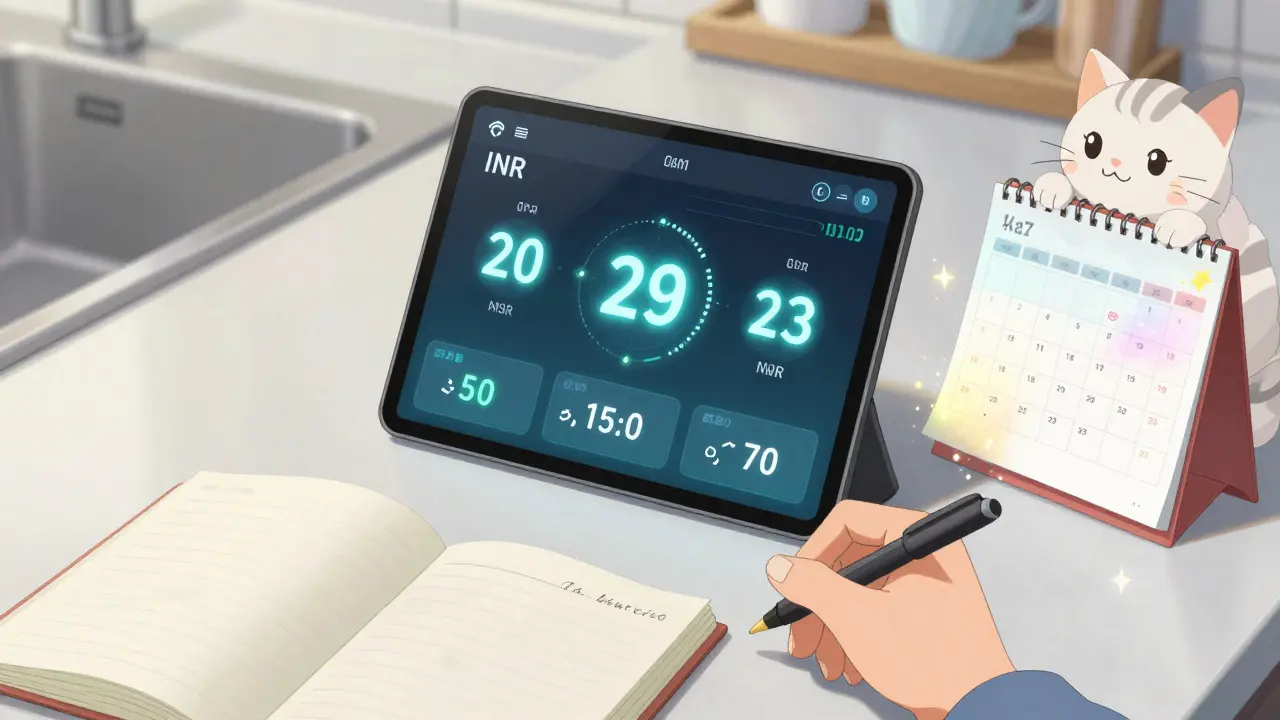
When Your Schedule Changes
Life doesn’t stay on schedule. You get sick. You change doses. You start a new med. That’s when your calendar becomes even more critical. For example, if you’re on lithium and your doctor adds a diuretic (water pill), your lithium level can spike overnight. You need a repeat test within 3-5 days. If your calendar doesn’t reflect that change, you won’t know. Same with warfarin. If you start antibiotics or switch to a new brand of vitamins, your INR can swing wildly. The rule? Any time your meds change, your lab schedule tightens. For the next 2-4 weeks, check more often. Then, if things stabilize, you can go back to your baseline. The key? Update your calendar immediately. Don’t wait. Don’t assume your doctor will remember. Write it down. Enter it in your app. Tell your pharmacist. Make it visible.Common Mistakes and How to Avoid Them
Here’s what goes wrong-and how to fix it:- Mixing up draw times: Lithium levels must be checked 12 hours after your last dose. If you take it at 8 PM, your blood draw should be at 8 AM. Do it at 10 AM? Your level looks artificially low. Set an alarm.
- Skipping tests because you feel fine: That’s how lithium toxicity sneaks up. You don’t feel dizzy until your level hits 1.5. By then, it’s too late.
- Not sharing your calendar: Bring it to every appointment-even if you think it’s “just a routine check.” Your doctor might not have seen your last result. Your pharmacist might not know you’re on clozapine.
- Waiting until the last minute: Labs need appointments. Results take days. If you wait until the day your test is due, you’ll miss it. Schedule ahead.
One patient I worked with on clozapine missed three ANC tests over six months because she thought she was “doing fine.” She ended up with a fever, sepsis, and a 10-day hospital stay. Her ANC had dropped to 300. She was lucky to survive. Her calendar? Still sitting on her fridge, untouched.
How to Build Your Own Lab Monitoring Calendar
You don’t need a fancy app. Start simple.- Get the official schedule: Ask your prescriber or pharmacist for the recommended monitoring plan. Don’t guess. Request written guidelines.
- Mark the dates: Use Google Calendar, Apple Calendar, or a paper planner. Color-code by test type: red for ANC, blue for INR, green for lithium.
- Set reminders: Two days before each test. One day before. On the day. Don’t rely on memory.
- Log results: After each test, write down the date, result, and reference range. Keep a notebook or digital file.
- Update with changes: Every time your dose changes, your meds change, or you get sick, adjust the calendar. Add a note: “Added furosemide-lithium check in 3 days.”
- Bring it to every visit: Even if you think it’s “just a follow-up.” Your doctor might not have access to your lab history.
Some hospitals, like Community Behavioral Health, offer downloadable templates. Others, like Taiho Oncology, have custom generators for drugs like LONSURF. Use them. They’re built by experts who’ve seen what happens when monitoring fails.

What’s Next for Lab Monitoring?
The future is smart. Wearables are starting to sync with lab calendars. Imagine your smartwatch detecting a drop in heart rate variability-something linked to low white blood cells-and prompting you: “Your ANC test is due tomorrow. Schedule now?” AI tools are being tested to predict side effects before they happen. If your last three ANC values dropped 10% each month, an algorithm might flag you for early intervention. But right now, those tools are still experimental. The foundation? Still the same: regular tests, accurate records, and a calendar you actually use.Frequently Asked Questions
Do I need a lab monitoring calendar if I feel fine?
Yes. Many dangerous side effects, like low white blood cell counts or rising lithium levels, don’t cause symptoms until they’re severe. Feeling fine doesn’t mean your labs are normal. Monitoring catches problems before you feel them.
Can I skip a lab test if I’m on vacation?
Don’t skip. Plan ahead. Find a lab near your destination and schedule the test. Many national chains like Quest or LabCorp accept orders from out-of-state providers. If you’re traveling internationally, talk to your doctor about temporary adjustments-but never skip entirely. Missing a test puts you at risk.
How long do I need to keep monitoring?
It depends on the drug. For clozapine, it’s lifelong. For lithium, it’s usually lifelong unless you stop the drug. For warfarin, it’s as long as you’re on it. Some drugs, like mirtazapine, only need 4-8 weeks of monitoring. Always ask your doctor for the duration. Don’t assume it’s temporary.
What if my lab results are out of range?
Don’t panic. Contact your prescriber immediately. Don’t wait for them to call you. Some results require same-day action-like an ANC below 500, which means you must stop your medication and go to the ER. Others, like a slightly high lithium level, may just need a dose adjustment. Know your red flags.
Can my pharmacist help with my monitoring calendar?
Yes. Pharmacists are trained in drug monitoring. They can remind you when tests are due, explain what your results mean, and flag interactions. Bring your calendar to your pharmacy visits. Many offer free monitoring reminders via text or phone.
Next Steps
If you’re on a high-risk medication:- Find your official monitoring schedule today.
- Set up calendar reminders for the next 3 tests.
- Download or print a tracking sheet.
- Bring it to your next appointment.
Don’t wait for a crisis to start paying attention. The right calendar doesn’t just help you stay safe-it gives you control. You’re not just taking a pill. You’re managing your health. And that starts with knowing when to get your blood drawn.
Mark Able
I used to skip my lithium checks because I felt fine. Then one day I woke up with my hand shaking like I had caffeine overdose and couldn’t hold a coffee cup. Turns out my level was 1.8. I almost went into renal failure. Now I set three alarms. One for the test, one for the night before, and one for the morning of. No excuses. Your body doesn’t care if you’re busy.
Also, if you’re on clozapine and think you can skip ANC tests because you’re ‘not sick’ - you’re one fever away from ICU. I’ve seen it. It’s not dramatic. It’s just silent and fast.
Stop guessing. Start tracking.
Dorine Anthony
My mom’s on warfarin and she uses a little paper calendar she got from her pharmacist. She colors in each test with a highlighter. Looks like a rainbow. She says it makes her feel like she’s winning. I used to think it was silly. Now I do the same for my thyroid meds. Simple works.
Also, don’t underestimate pharmacists. They know more than your doctor sometimes about timing and interactions. Just ask.
William Storrs
Look - I know this stuff feels like a chore. But think of it like brushing your teeth. You don’t wait until your gums bleed to start. You do it because you know what happens if you don’t.
Set up your calendar today. Not tomorrow. Not next week. TODAY. Even if it’s just a sticky note on your mirror. Your future self will thank you. And if you need help building one, DM me. I’ve got templates for everything - lithium, clozapine, even steroids. Free.
You got this.
James Stearns
It is profoundly regressive that we still rely on patient self-reporting and manual calendar maintenance in the 21st century. The pharmacokinetic profiles of these agents are well-characterized; the clinical guidelines are standardized. Why, then, do we permit a system predicated on the cognitive load of non-medically trained individuals to determine life-or-death outcomes?
One must conclude that the healthcare industrial complex prioritizes cost containment over patient safety. The burden of compliance is externalized onto the vulnerable. This is not healthcare. It is institutional negligence dressed in motivational platitudes.
Nina Stacey
OMG I just realized I forgot my ANC test last month and I’m on clozapine and I’ve been feeling kinda tired but I thought it was just work stress and now I’m scared I’m gonna die and I don’t even know how to get a lab done near me and I think my doctor hates me because she never calls back and I just wanna cry but also I’m mad at myself for being lazy but also I’m just so tired all the time and I don’t know what to do anymore please help
also does anyone know if quest accepts out of state orders because I’m in california and my doctor is in texas and I’m not sure if I can just walk in or if I need a new prescription or if i need to like beg my doctor to email something or if i’m just doomed
Dominic Suyo
Let’s be real - this whole lab calendar thing is a scam designed by Big Pharma to keep you hooked. You think they care if you live or die? Nah. They care if you keep coming back for more tests, more meds, more paperwork. The real side effect? Your soul getting drained by bureaucracy.
And don’t get me started on these ‘digital tools.’ Who’s coding them? Some intern in Bangalore who’s never met a patient? You think an app knows when you’re dehydrated? Please. Your body’s screaming. Listen to it. Not your phone.
They want you dependent. Don’t be their puppet.
Kevin Motta Top
My cousin on lithium missed a test. Got hospitalized. Now she uses a calendar app with color-coded alerts. She’s been stable for three years. Simple. Consistent. Doesn’t need to be fancy.
Just do it.
Alisa Silvia Bila
I used to think this was overkill until I started tracking my INR and noticed it spiked every time I ate kale. Not the spinach - the kale. I had no idea. Now I avoid it on test days. Little things matter. And yeah, it’s annoying to log everything, but it’s less annoying than bleeding out in the bathroom because your INR was 6.2 and no one knew.
Also, if you’re on steroids, don’t stop cold turkey. That’s not a myth. That’s a death sentence waiting to happen.
William Liu
My brother’s on clozapine. He missed two tests. Got sepsis. Spent 18 days in the hospital. He’s fine now, but he’ll never skip again. He prints out his calendar, laminates it, and hangs it next to his toothbrush. Every morning. Every night. He says it’s his new prayer.
Don’t wait for your version of that.
Aadil Munshi
You think this is about medicine? No. This is about control. The system wants you to believe that your survival depends on following a calendar. But what if the real problem is the drug itself? Why are we giving people drugs that require constant surveillance just to function? Why not fix the root cause? Depression, psychosis - these are social conditions, not chemical imbalances.
But no, let’s keep giving people lithium and call it treatment. Meanwhile, the real issue - poverty, trauma, isolation - remains untouched. You’re not failing because you forgot a test. You’re failing because the system failed you first.
Frank Drewery
I know how overwhelming this feels. I’ve been there. I used to cry before every blood draw because I was so scared of what the numbers would say.
But I found a community online - just people sharing their calendars, their results, their bad days. No judgment. Just: ‘I missed mine too. Here’s how I got back on track.’
You’re not alone. And it’s okay to need help. Just ask.
jessica .
Did you know the FDA only approved clozapine because the drug company bribed the regulators? They knew about the blood issues but covered it up. Now they make billions off your weekly blood draws. The real danger isn’t the drug - it’s the system that profits from your fear.
And don’t let them tell you this is ‘healthcare.’ It’s surveillance with a stethoscope.
They’re watching you. Always.
Ryan van Leent
People who skip lab tests are just lazy and irresponsible. If you can’t follow a simple schedule then you shouldn’t be on these meds. You’re a danger to yourself and others. I’ve seen people on lithium who didn’t test and then they went off the rails and attacked their family. It’s not a coincidence. It’s negligence.
Stop making excuses. Do the test. Or stop taking the pill. Either way, stop pretending you’re a victim.
Sajith Shams
You think you’re the first person to need a calendar? No. This has been standard since the 1970s. The fact you’re asking how to start means you’ve been negligent. You’re lucky you’re alive. You should be grateful you’re even allowed to take these drugs. Most countries don’t even give them to people who can’t manage basic compliance.
Read the FDA guidelines. Read the manufacturer’s inserts. Stop asking for hand-holding. Do your homework.
Isabel Rábago
I used to think I could just wing it. I was on prednisone for six months and never checked cortisol. Then I got sick and passed out in the grocery store. Turns out my adrenal glands had shut down. I almost died. Now I have a calendar. I color-code it. I set reminders. I bring it everywhere.
It’s not about being perfect. It’s about being alive. And if you’re still skipping tests because you’re ‘too busy’ - you’re not busy. You’re just not prioritizing your life.