

When someone gets a kidney, liver, or heart transplant, their body doesn’t just accept the new organ. It fights it. That’s why immunosuppressants like cyclosporine and tacrolimus are life-saving. But here’s the problem: even though generic versions of these drugs are cheaper, switching between them can be dangerous. Not all generics are created equal. And for transplant patients, that difference can mean the difference between survival and rejection.
Why These Drugs Matter
Cyclosporine and tacrolimus are both calcineurin inhibitors. That means they block a key signal in the immune system - the one that tells T-cells to attack foreign tissue. Without them, most transplanted organs would be rejected within days. Cyclosporine was the first of its kind, approved in 1983. Tacrolimus came later, in 1994, and quickly became the go-to because it worked better. Studies show it cuts acute rejection rates in half compared to cyclosporine. For example, in a 2005 trial, only 19.6% of patients on tacrolimus had rejection within six months, versus 37.3% on cyclosporine. It also helped preserve kidney function longer. Today, over 85% of new transplant patients in the U.S. start on tacrolimus.The Cost Difference Is Huge
Brand-name tacrolimus (Prograf) used to cost $1,200 to $1,500 a month. Generic versions now run $300 to $500. Cyclosporine went from $800-$1,000 to $150-$300. That’s a massive savings - and that’s why insurers and Medicare Part D push for generics. In fact, over 92% of these drugs prescribed in the U.S. are generic. But here’s the catch: these aren’t like taking a generic ibuprofen. These drugs have a narrow therapeutic index. That means the difference between a dose that works and one that’s toxic is tiny.How Generic Switching Can Go Wrong
Generic drugs must prove they’re bioequivalent to the brand. The FDA says the amount of drug absorbed into the bloodstream (AUC) and the peak level (Cmax) must fall within 80-125% of the original. Sounds strict, right? But that range is still wide enough to cause problems. For tacrolimus, the target blood level is 5-15 ng/mL. A shift from 8.5 ng/mL to 5.2 ng/mL - which happened to a Reddit user after switching generics - can trigger rejection. Another patient reported tremors and headaches after switching, only to find their tacrolimus level had spiked to 22 ng/mL. Too high? Risk of kidney damage. Too low? Risk of organ rejection.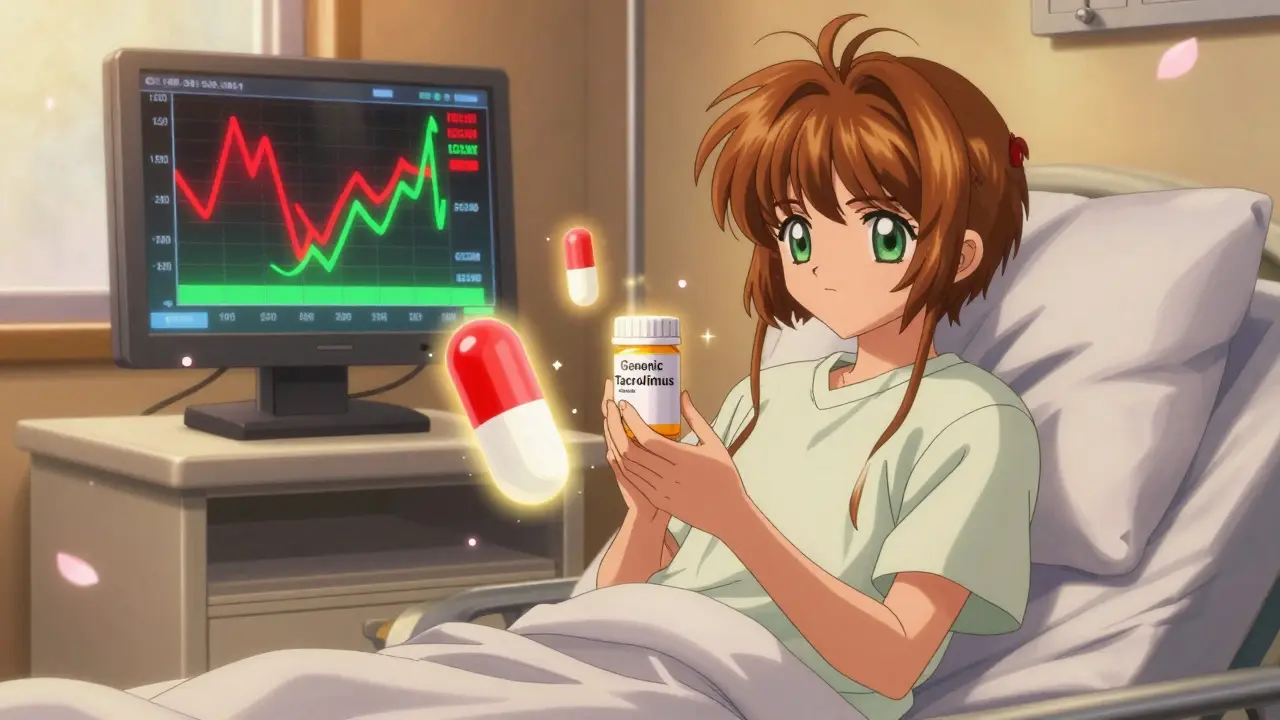
Why Cyclosporine Is Even Trickier
Cyclosporine has more formulation issues than tacrolimus. The original version (Sandimmune) was an oil-based solution that absorbed inconsistently. The newer version (Neoral) is a microemulsion that’s more reliable. But even then, different generic manufacturers use different oils, surfactants, and particle sizes. One patient might get a generic made by Sandoz, then later get one from Teva. Their blood levels might swing by 30% or more. A 2023 study found only 41.7% of generic manufacturers provide detailed bioequivalence data to doctors. So clinicians are flying blind.Real Stories, Real Risks
On transplant forums, the complaints are consistent. A 2024 survey of 1,247 transplant patients found 42.7% noticed new side effects after switching to generic tacrolimus. One in five had to adjust their dose because their levels became unstable. In the United States Renal Data System, non-adherence rates were 15.3% higher among patients on generics - not because they stopped taking the drug, but because they feared it wasn’t working. One user wrote: "My nephrologist won’t let me switch back to brand because my insurance won’t pay. But I’ve been on edge for two years, waiting for my levels to drop again." On the flip side, some patients do fine. "I switched to generic tacrolimus 18 months ago," wrote one user on HealthUnlocked. "My levels are stable. I save $900 a month. No issues." But those stories are the exception, not the rule. The difference? Consistency. If you stay on the same generic manufacturer, your body adapts. The danger comes from switching between generics.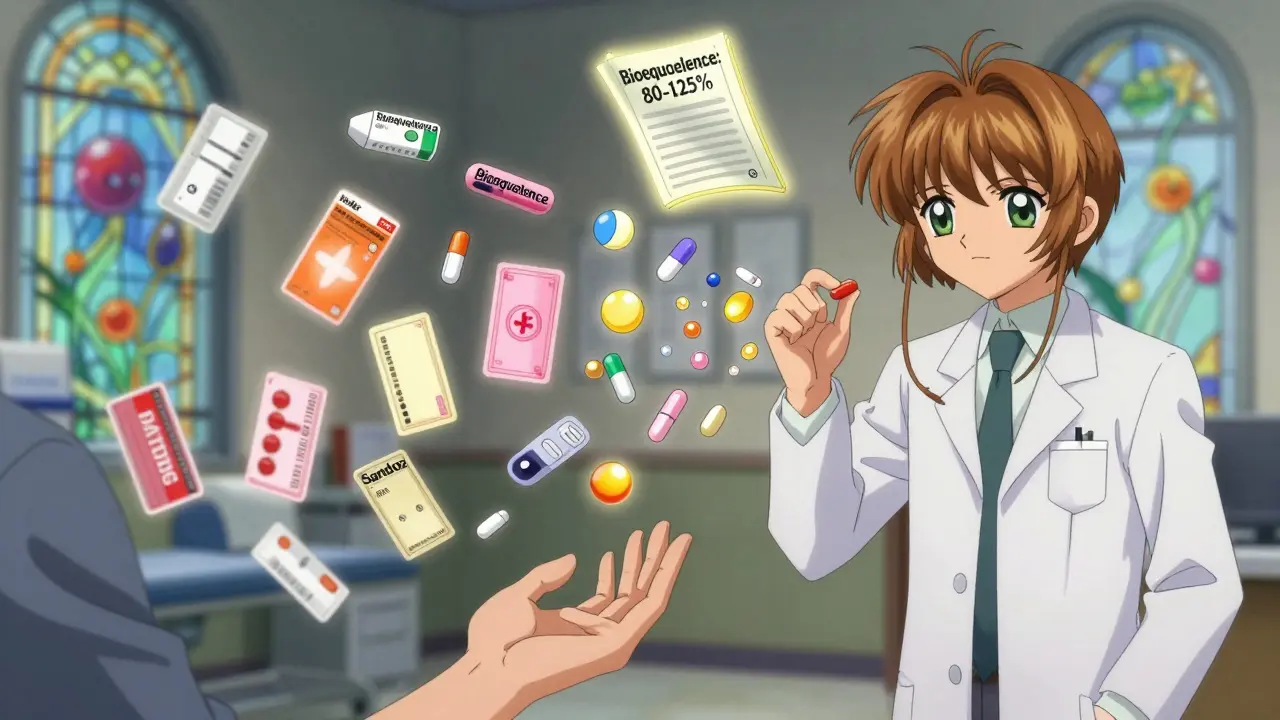
What Transplant Centers Are Doing
Most transplant centers now have strict rules. If you’re on a generic, they don’t let you switch unless absolutely necessary. Many now sign contracts with just one generic supplier - so every patient gets the same version. A 2023 survey found 67.4% of major transplant programs use this "single generic source" strategy. Pharmacists monitor blood levels weekly for the first month after any switch. They also warn patients to avoid grapefruit, which can spike drug levels, and to take the drug at the same time every day - within one hour.New Developments to Watch
In late 2023, Astellas got FDA approval for a new extended-release version of tacrolimus called LCP-tacrolimus. It’s designed to release the drug slowly, reducing those dangerous peaks and valleys. Early data shows it cuts variability by over 40%. Meanwhile, the European Medicines Agency now requires bioequivalence studies to use actual transplant patients, not just healthy volunteers - a big step forward. And researchers are starting to use genetic testing. Some people have a gene variant (CYP3A5) that breaks down tacrolimus faster. Tailoring doses to genetics can get patients into the safe range 63% faster.What You Need to Do
If you’re on cyclosporine or tacrolimus, here’s what matters:- Never switch between generic brands without talking to your transplant team.
- Ask which generic manufacturer your pharmacy uses - and stick with it.
- Get your blood levels checked right after any switch - even if you feel fine.
- Keep a log of side effects: tremors, headaches, nausea, or changes in urine output.
- Never skip doses. Missing one can cause a dangerous drop in levels.
- Avoid grapefruit, pomegranate, and St. John’s wort - they interfere with these drugs.
The bottom line: generics save money. But for transplant patients, they’re not interchangeable. Your body doesn’t care about the label. It only cares about the amount of drug in your blood. And that’s something you can’t afford to guess.
Can I switch from brand to generic tacrolimus safely?
Yes - but only under close medical supervision. Your doctor should check your blood levels before the switch, then again at 1 week, 2 weeks, and 4 weeks after. If your levels stay within the target range (5-15 ng/mL) and you have no new side effects, it’s likely safe. But never switch without your transplant team’s approval.
Why can’t I just use the cheapest generic available?
Because "cheapest" doesn’t mean "same." Different manufacturers use different inactive ingredients, which affect how the drug is absorbed. One generic might release the drug faster than another, causing spikes or dips in your blood levels. For drugs with a narrow therapeutic index like tacrolimus, even small changes can lead to rejection or toxicity.
How often should my drug levels be checked after switching generics?
Weekly for the first month. After that, every 2-4 weeks for the next two months. Once you’re stable on the same generic for 3 months, checks can go back to monthly or as your doctor recommends. But if you switch manufacturers again, you restart the weekly monitoring.
Is cyclosporine or tacrolimus safer as a generic?
Tacrolimus generics are more commonly used and have better overall consistency, but both carry risks. Cyclosporine has more formulation variability because of its oil-based delivery system. Tacrolimus has tighter dosing requirements and higher rates of side effects like diabetes and tremors. Neither is "safer" - both require strict monitoring.
What should I do if my insurance forces me to switch to a different generic?
Contact your transplant center immediately. They can often file an appeal with your insurer, citing medical necessity. Many centers have pharmacists who help with this process. In the meantime, get your blood levels checked before and after the switch. Document any new symptoms. Your safety matters more than cost savings.
Jacob Carthy
Look i dont care what the FDA says or some study. If my kidney is gonna survive i want the same damn pill every time. Switching generics is like playing russian roulette with your organs. My brother lost his liver because they switched him to a cheaper one without telling him. Now he's back on the list. Fuck cost savings when your life's on the line.
Lisandra Lautert
This isn't about money. It's about control. Your body doesn't negotiate. It doesn't care if the pill is labeled 'generic.' It just reacts. And when it reacts wrong? You don't get a second chance.
Cory L
Man i used to think generics were just cheaper versions of the same thing. Then i met a guy at the transplant center who told me his blood levels swung like a pendulum after switching brands. One week he felt fine. Next week he was in the ER with tremors and kidney pain. Turns out the new generic had a different coating. It's wild how something so small can wreck your whole life. Stay consistent. Stick to one. Don't gamble.
Bhaskar Anand
In India we have no such luxury. We take what is available. If you can afford brand name, good for you. But most of us are not so lucky. The system is broken. But complaining about generics? That's a rich man's problem. We need these drugs. We need them now. And if a generic saves a life, even if imperfect, then it's better than nothing. Stop whining and be grateful.
William James
I think we're all just trying to survive here. Some folks get lucky and stay stable on generics. Others get crushed by the system. Maybe the real issue isn't the drugs. It's that we treat medicine like a commodity instead of a right. Your body doesn't have insurance. It doesn't have a deductible. It just needs the right dose. And if we can't guarantee that... then we've failed.
David McKie
I'm sick of this. People think they're saving money by switching generics. But they're not. They're just delaying the inevitable hospital bill. One rejection episode costs over $200,000. The generic saves $900 a month? So what? You're gambling with taxpayer money, insurance funds, and human lives. This isn't capitalism. This is negligence dressed up as savings.
Southern Indiana Paleontology Institute
My cousin is a transplant patient. He's been on the same generic for 5 years. No issues. He says the pharmacy never changes it. So why is everyone freaking out? If your pharmacy sticks with one brand, you're fine. The problem isn't generics. It's pharmacies switching them around like candy. Stop blaming the pill. Blame the system that lets them swap it.
Anil bhardwaj
I read this whole thing. I'm not a doctor. But I know this: consistency matters. If you take the same pill every day, your body learns it. Switching is like changing your alarm clock every week. You never get used to it. So don't switch. Ever. If your pharmacy gives you a different pill, say no. Demand the same one. It's not about money. It's about survival.