
When you walk into a doctor’s office, pharmacy, or clinic, you’re not just there for a quick check-up. You’re there to make sure your medications are working, not hurting you. But too often, patients forget what they’re taking, doctors miss changes, and errors slip through. That’s where a Medication Action Plan comes in. It’s not just a piece of paper. It’s your safety net.
What Is a Medication Action Plan (MAP)?
A Medication Action Plan is a simple, structured form that helps you and your provider talk clearly about your medicines. It’s not a list. It’s a conversation starter, a tracker, and a record-all in one. Developed under Medicare Part D guidelines and standardized by CMS (Centers for Medicare & Medicaid Services) as form CMS1245776, the MAP is used in over 89% of community pharmacies in the U.S. and required in comprehensive medication reviews for millions of seniors.The template includes four core sections: What we talked about, What I need to do, What I did and when I did it, and My follow-up plan. It also asks for your name, the date it was created, your provider’s contact info, and space for signatures from both you and your provider. In Germany, where a similar plan has been law since 2016, 87.5% of patients could find critical info on their first try-just by using the standard format.
Why does this matter? Because medication errors cause over 150,000 preventable hospitalizations each year in the U.S. alone. The MAP cuts that risk by helping everyone-patients, pharmacists, doctors-stay on the same page.
What Goes Into a Medication Action Plan?
Not every template is the same, but the best ones share the same essentials. Here’s what you should expect to see:- Medication list: Brand name, generic name, dose, frequency, and reason for taking it. Example: Metformin 500mg, twice daily, for type 2 diabetes.
- Changes made: New meds, stopped meds, dose changes-with exact dates. Stopped lisinopril on 1/15/2026 due to cough.
- What you need to do: Clear, specific instructions. Not “Take as directed”, but “Take insulin at 7 a.m. and 7 p.m., 30 minutes before meals”.
- Adherence tracking: A simple box to mark if you took your pill each day. Some use checkmarks. Others use a calendar.
- Symptom triggers: For as-needed meds, like painkillers or inhalers. Example: “Use albuterol if wheezing starts or peak flow drops below 70%”.
- Questions for next visit: Space to write down concerns you don’t want to forget.
- Emergency info: Who to call, where to go if something goes wrong.
Some templates even include side effects to watch for. PharmCompliance’s version, for example, asks you to note unexpected symptoms like dizziness, swelling, or rashes. These details matter. A 2021 study found that plans with specific symptom triggers reduced emergency visits by 23% in patients with asthma and heart failure.
How to Use It Before Your Visit
Don’t wait until you’re in the exam room to figure this out. Preparation is half the battle.- Update your list: Before your appointment, take out all your pill bottles. Cross out anything you stopped taking. Add anything new-even over-the-counter pills, vitamins, or herbal supplements. Write down the date you started or stopped each one.
- Bring the actual bottles: Don’t just bring the paper. Bring the real bottles. Studies show this improves accuracy by 37.2%. Your doctor can see the label, the strength, the expiration date. You can’t trust memory.
- Fill in what you did: If you missed doses, write why. “Forgot because of work schedule.” “Ran out and couldn’t refill.” Honesty here helps your provider fix the problem, not just blame you.
- Write down your questions: Use the “Questions I want to ask” section. Example: “Why did you take me off my blood pressure pill?” or “Is this new pill safe with my arthritis meds?”
One patient from Ohio told the Medicare Rights Center forum: “I started bringing my MAP to every appointment. My cardiologist spotted I was taking two blood pressure meds that clash. He changed it right then. I avoided a hospital stay.”
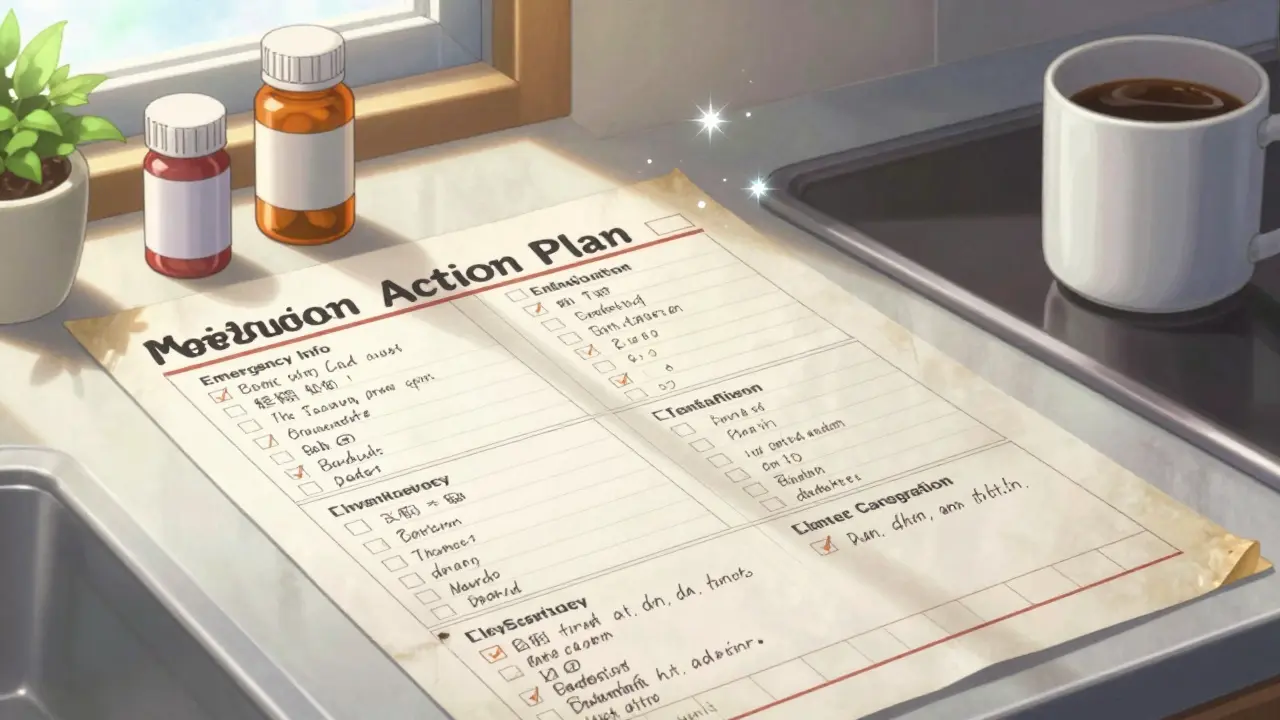
How to Use It During Your Visit
When you sit down with your provider, hand them the MAP. Don’t assume they’ve seen it. Don’t assume they’ll ask about it.- Start with the “What we talked about” section: Say, “Last time we talked about my blood sugar going too low. I’ve been having shakes after lunch.” Let them update this part.
- Review the “What I did” section together: Pharmacists spend an average of 3.7 minutes just on this during MTM visits. If you say you took your pill every day but the box is half-empty, they’ll ask why. That’s good. It’s not judgment-it’s problem-solving.
- Update in real time: If your doctor changes your meds, have them write it on the MAP right then. Cross out old meds with the date and reason. Add new ones with start date and instructions. Don’t let them say, “I’ll put it in the computer.” The computer might not sync. The paper doesn’t lie.
- Ask about high-risk meds: Especially if you’re over 65. Certain drugs-like benzodiazepines, anticholinergics, or even some sleep aids-can increase fall risk. Ask: “Is this one safe for me?” AHRQ says providers should spend 8-12 minutes on this alone for older adults.
- Get it signed: Both you and your provider should sign and date the updated plan. This makes it official. It’s not just a reminder-it’s a legal record.
Dr. Sarah Spinler, editor-in-chief of Pharmacotherapy, says: “The quality of the action plan documentation directly correlates with outcomes. Specific, time-bound instructions lead to 2.3 times better adherence.”
What Happens After the Visit
The plan doesn’t end when you leave the office.- Give copies to everyone: Share it with your pharmacist, your family, your caregiver. If you go to the ER, bring it. Emergency staff can’t guess what you’re on. A 2021 NIH study found patients who shared their MAP with multiple providers had 22.8% fewer duplicate prescriptions.
- Keep it where you can find it: Laminated wallet-sized versions work best for older adults. AARP’s 2022 survey found 68.3% of seniors over 65 prefer paper over apps. If you lose it, you lose your safety net.
- Update it weekly: Even if you don’t have a visit, take 5 minutes every Sunday to check your boxes, add new meds, or cross out old ones. It takes less time than a phone call to refill.
One pharmacist in North Carolina told a Reddit thread: “Many elderly patients lose their MAPs. We started printing them on waterproof plastic. Now they fit in a wallet. Compliance jumped from 38% to 81%.”
Why This Works Better Than a Medication List
A simple list of pills? That’s a starting point. A Medication Action Plan? That’s a living tool.- A list says: “I take insulin.”
- A MAP says: “I take insulin 10 units at breakfast and dinner. I’ve missed 3 doses in the last week because I don’t eat lunch. My blood sugar is above 200 on those days. I need help adjusting my schedule.”
The MAP turns vague complaints into actionable plans. Research from the Journal of the American Pharmacists Association shows MAPs reduce medication discrepancies by 41.7% during care transitions-like going from hospital to home.
And it’s not just for seniors. People with diabetes, heart disease, depression, or multiple prescriptions benefit just as much. The Institute for Safe Medication Practices found that failure to document discontinuation dates was the #1 error in medication reconciliation-responsible for nearly 19% of mistakes. The MAP fixes that.
Common Mistakes and How to Avoid Them
Not everyone uses the MAP right. Here are the top errors-and how to dodge them:- Mistake: Writing vague instructions. “Take as directed.” Solution: Always specify dose, time, and reason. “Take 1 pill at 8 a.m. with food for high blood pressure.”
- Mistake: Not updating after changes. Solution: Update it the same day you get a new prescription.
- Mistake: Forgetting non-prescription meds. Solution: Include vitamins, herbal supplements, and OTC painkillers. They interact too.
- Mistake: Not bringing it to every visit. Solution: Treat it like your ID. If you don’t have it, you don’t go.
- Mistake: Not sharing with caregivers. Solution: Give a copy to your spouse, child, or neighbor. They might notice something you miss.
And remember: the MAP isn’t a punishment. It’s a tool. It’s not about being perfect. It’s about being safe.
Do I need a Medication Action Plan if I only take one or two medications?
Yes. Even if you take just one or two meds, the MAP helps you track side effects, remember why you’re taking them, and catch interactions. A 2023 study found that 30% of medication errors in patients taking fewer than three drugs came from miscommunication-not complexity. The MAP prevents those errors.
Can I use a digital version instead of paper?
Some apps and EHRs have digital versions, but paper is still the gold standard. Most patients over 65 prefer paper, and emergency responders can’t always access your phone or portal. If you use a digital version, make sure you can print a copy instantly. Always carry a physical backup.
What if my provider doesn’t use the template?
Bring it anyway. Say: “I’ve been using this to keep track of my meds. Could you help me update it?” Most providers will appreciate it. If they refuse, ask for a copy of your updated list in writing. Your safety matters more than their workflow.
Is this only for Medicare patients?
No. The MAP was developed for Medicare, but it works for anyone. Medicaid, private insurance, and even self-pay patients benefit. The CDC and AHRQ recommend it for all adults taking multiple medications-no matter how they pay.
Where can I get a free Medication Action Plan template?
The CDC offers a free, printable version called MyMedications Action Plan. You can also get one from your pharmacy, Medicare plan, or local health department. PharmCompliance sells a paid version, but you don’t need to pay. The CMS standard template is public and free to use.
Aisling Maguire
I started using this after my grandma almost got hospitalized from mixing her blood pressure meds with that herbal tea she swears by. Now she carries a laminated copy in her purse like a driver’s license. Best thing I ever did. Seriously, if you’re on more than one thing, just do it. No excuses.
Lisa Fremder
This is why America’s healthcare is broken. You need a fucking worksheet just to not die taking your pills? My grandpa died because some nurse misread his scribbled list. This template is a bandaid on a gunshot wound.
Justin Ransburg
I can’t emphasize enough how transformative this has been for my patients. One 72-year-old woman came in last week with her MAP fully updated, signed, and even color-coded by pill type. She said, ‘I finally feel like I’m in control.’ That’s not just compliance-it’s dignity. We need to normalize this across all clinics, not just Medicare.
Sumit Mohan Saxena
The structural integrity of the Medication Action Plan is fundamentally aligned with WHO’s Guidelines on Medication Safety in Primary Care. The four-section framework mirrors the ICH E2E standard for adverse event documentation. Furthermore, the inclusion of symptom triggers directly correlates with the 2021 Cochrane Review on patient-reported outcomes. This is not merely a tool-it is an evidence-based intervention.
Brandon Vasquez
I’ve been using this for two years. I don’t talk much, but I’ll say this: it saved me. I missed a dose once, didn’t tell anyone, and ended up in the ER. Now I update it every Sunday. My wife checks it too. It’s quiet. It’s simple. But it works.
Vikas Meshram
You people are missing the point. The CMS template is outdated. The real solution is blockchain-based medication logs synced with your pharmacy’s EHR. Paper? Please. I’ve seen patients lose these things 3 times in a month. You think a laminated sheet solves anything? You’re just delaying the inevitable. Digital first. Always.
Ben Estella
I work in an ER. Saw a guy come in last month with 17 different pills in his pocket. No list. No idea what any of them did. He was on three that shouldn’t be taken together. We had to call his primary care. He didn’t even have a MAP. That’s not negligence-it’s negligence with a side of arrogance. If you’re not using this, you’re gambling with your life.
Jimmy Quilty
You realize the CMS template was designed by lobbyists, right? The whole thing is a trap. They want you to believe you’re safe because you have a piece of paper. Meanwhile, your data’s being sold to drug companies. And who signs it? Your doctor? Who’s to say they didn’t just scribble ‘approved’ without reading it? I’ve got a friend who got prescribed a drug he was allergic to because the MAP had a typo. Typo. One letter. That’s all it took.
Miranda Anderson
I used to think this was overkill until my mom had a stroke and we found out she’d been taking two different versions of the same blood thinner for six months because the pharmacist didn’t know she’d switched brands. The MAP didn’t just help-it became our family’s lifeline. Now we all have copies. My 14-year-old daughter updates it every Sunday with me. It’s weirdly bonding. I didn’t expect that. But now I can’t imagine not having it. It’s not about being perfect. It’s about being present. And honestly? It’s kind of beautiful.