

Handling expired controlled substances isn’t just about cleaning out a medicine cabinet. If you’re a pharmacist, doctor, vet, or researcher, improper disposal can lead to fines, legal trouble, or even contribute to opioid diversion. The DEA doesn’t allow flushing, dumping, or throwing these drugs in the trash. Controlled substances - especially Schedule II drugs like oxycodone, fentanyl, or morphine - have strict rules because they’re high-risk for abuse. Getting it wrong isn’t just a mistake; it’s a violation of federal law.
Why You Can’t Just Throw Them Away
- These drugs are still potent, even after expiration. A 10-year-old pill of hydrocodone can still cause an overdose.
- Landfills and sewage systems don’t destroy these chemicals. They end up in water supplies or get dug up by animals or people.
- According to the DEA’s 2022 Enforcement Report, 327 warning letters were issued for improper disposal - and $2.47 million in fines were collected.
- Studies show that 14.3% of veterinary drug diversion cases trace back to poor disposal practices.
The FDA says you can mix regular expired pills with coffee grounds or kitty litter - but that advice does not apply to controlled substances. The DEA explicitly bans this method for any drug with a high potential for abuse. Even if the bottle says "dispose of unused medication," that’s not legal for Schedule I-V drugs.
Understanding DEA Schedules
Controlled substances are grouped into five schedules based on abuse risk and medical use. Your disposal method depends on which schedule the drug falls under:
- Schedule I: No medical use (e.g., heroin, LSD). These are rare in clinical settings but still require reverse distributor disposal.
- Schedule II: High abuse risk, severe dependence (e.g., oxycodone, fentanyl, Adderall). These require DEA Form 222 and reverse distributor handling.
- Schedule III-V: Lower abuse risk (e.g., ketamine, codeine, benzodiazepines). Some can be destroyed on-site with witness logs.
Most healthcare facilities deal mostly with Schedule II and III drugs. Schedule II is the most tightly controlled - and the most expensive to dispose of.
Two Main Disposal Paths: Inventory vs. Wastage
The DEA distinguishes between two types of disposal:
Inventory Disposal (Large Quantities)
This applies when you’re clearing out an entire stock - expired inventory, discontinued medications, or surplus from closed departments. Here’s how it works:
- Label all containers clearly: "To be disposed," "Expired," "Do Not Use."
- Segregate them from active inventory in a locked, secure area.
- Contact a DEA-registered reverse distributor. Companies like Stericycle, Daniels Health, or Drug and Laboratory Disposal, Inc. (DLD) handle this.
- Complete DEA Form 222 for Schedule II substances. As of January 2023, this must be done electronically via the Electronic Registration System (ERS). Paper forms are no longer accepted.
- Wait for pickup. Average wait time? 14.7 business days, according to a University of Michigan survey.
- Pay the fee. Average cost: $250-$500 per pickup, depending on volume and location.
- Keep records for at least two years. Include the DLD Chain of Custody Form or DEA Form 41.
Wastage (Small Quantities)
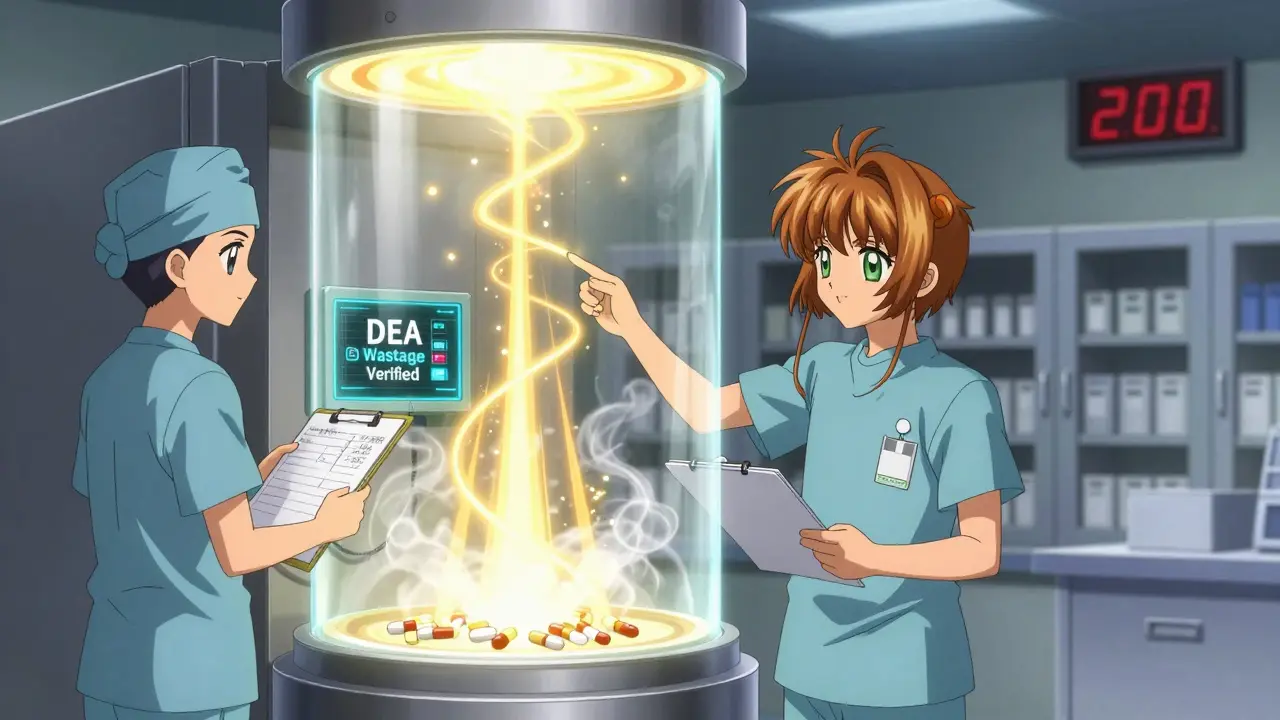
This is for small amounts left over after a single dose - a few drops of injectable fentanyl, a half-used patch, or a crushed tablet that can’t be administered. Wastage can be destroyed on-site, but with strict rules:
- Two authorized personnel must witness the destruction. One must be the registrant or an authorized agent.
- They must document: date, time, substance name, quantity, method, and signatures.
- Methods: Incineration in a certified biohazard unit is the only DEA-approved method. Crushing, dissolving in water, or pouring down the drain is illegal.
- Record everything. These logs must be kept for two years.
UCSF and the University of Michigan both require that wastage be logged in their internal systems - UCSF uses Research Inventory Online (RIO), while Michigan uses paper logs. A 2022 DEA audit found that 18.7% of dental practices using paper logs made errors. Digital systems cut that risk significantly.
What You Absolutely Cannot Do
Here’s a list of illegal and dangerous disposal methods - even if you’ve heard them from coworkers:
- Flushing: Never. The FDA says this is for general meds only - and even then, it’s discouraged. For controlled substances? Absolutely forbidden.
- Throwing in trash: Even if it’s in a sealed bag. Someone could dig it out.
- Mixing with kitty litter or coffee grounds: This works for aspirin or ibuprofen - not fentanyl.
- Pouring down the sink: Contaminates water. Violates EPA and DEA rules.
- Using blue pads or sharps containers: These are for biohazard or needle waste - not drugs.
- Donating or giving away: Even to a patient. Expired controlled substances are legally unusable.
Training and Documentation Are Non-Negotiable
Every person who handles these drugs must be trained. The DEA requires:
- Initial 2-hour training on disposal procedures
- Annual 1-hour refresher
But here’s the problem: a 2022 audit of 417 dental practices found only 67.3% were compliant. Many clinics skip training because they think it’s "just paperwork." It’s not. The DEA is cracking down. In 2022, they conducted 1,847 inspections - up 23.6% from the year before.
Documentation isn’t optional. You need:
- Disposal logs with signatures
- DEA Form 222 (for Schedule II)
- Chain of custody records
- Proof of reverse distributor pickup
Store all records for at least two years. If you’re audited and can’t produce them, you’re in violation.
Real-World Challenges and Fixes
Here’s what people actually struggle with:
- Cost: Small clinics and vet offices get hit hard by $500 disposal fees. Solution: Group with nearby practices to consolidate pickups.
- Delays: Waiting 2+ weeks for a reverse distributor pickup. Solution: Schedule pickups quarterly, not reactively.
- Confusion: Vets especially get mixed messages. The AAHA found 43.6% of small animal practices didn’t know the rules. Solution: Use the DEA’s online disposal locator (updated November 2022).
- Staff turnover: New hires don’t know the protocol. Solution: Make training part of onboarding - and keep a printed checklist posted near the storage area.
On the flip side, institutions like UCSF report high satisfaction. Their RIO system lets staff submit disposal requests in under 5 minutes. 82.4% of users called it "streamlined." Digital tools are the future.
What’s Coming Next
The DEA is moving fast:
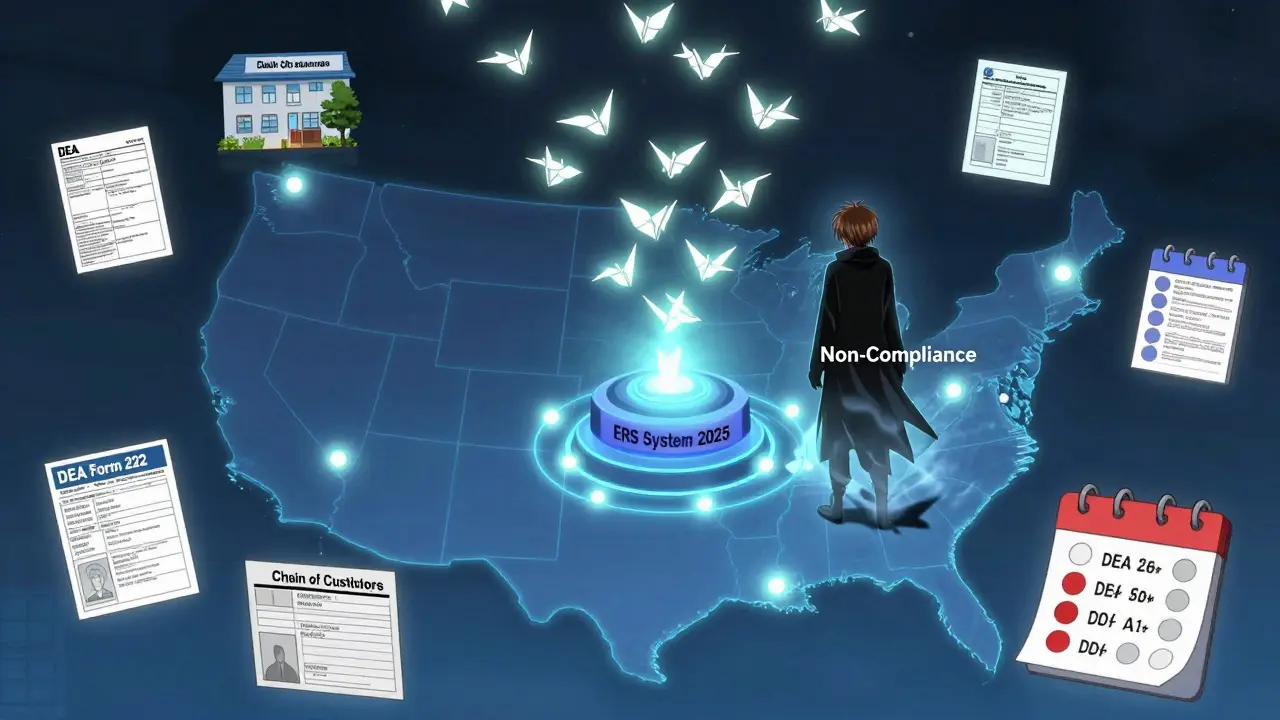
- Electronic Inventory Management System (EIMS): Launching in 2025. This will require real-time reporting of all controlled substance movements - including disposal. No more paper logs.
- Increased penalties: Fines are rising. The DEA expects compliance rates to hit 92.7% among healthcare facilities by 2027.
- More take-back events: National Take Back Day 2023 collected nearly 900,000 pounds of medication. More communities are hosting monthly drop-offs.
If you’re not already using digital systems, start now. Waiting means you’ll be left behind - and possibly fined.
Quick Action Checklist
Here’s what to do right now:
- Check your inventory. Label all expired or unused controlled substances.
- Separate them from active stock. Lock them up.
- Identify if they’re Schedule II or III-V.
- For Schedule II: Use ERS to file DEA Form 222. Contact a reverse distributor.
- For Schedule III-V: If small amounts, arrange two-person witnessed destruction. If large, use reverse distributor.
- Record everything. Save copies for two years.
- Train your team. If no one’s been trained in the last year, schedule it.
Can I dispose of expired controlled substances at a pharmacy?
No. Most pharmacies only accept non-controlled medications through take-back programs. Controlled substances require DEA-registered reverse distributors or on-site destruction with witnesses. Pharmacies are not authorized to destroy Schedule II-V drugs on behalf of clinics or hospitals.
What happens if I don’t dispose of expired controlled substances?
You risk DEA fines, loss of your registration, and potential criminal charges. The DEA conducts random inspections. In 2022, 327 warning letters were issued for improper disposal, and fines totaled over $2 million. Even a single unreported expired pill can trigger an audit.
Are there any free disposal options for small practices?
Not really. Reverse distributors charge for pickup, and fees are rising. However, some state health departments or regional coalitions offer discounted bulk disposal for small clinics or veterinary offices. Check with your state’s board of pharmacy or the DEA’s online locator tool. National Take Back Day events are free but only accept non-controlled drugs.
Can I destroy Schedule III-V drugs myself?
Yes - but only if you follow the wastage protocol. Two authorized personnel must witness the destruction, and it must be done by incineration. You must document the date, time, substance, quantity, and signatures. Crushing, dissolving, or pouring into a sink is illegal. Always check your institution’s policy - some require you to use a reverse distributor regardless.
How do I find a DEA-registered reverse distributor?
Use the DEA’s online disposal locator, updated in November 2022. Enter your zip code and select "Reverse Distributor." You’ll get a list of approved companies in your area. Stericycle, Daniels Health, and DLD are the top three. Always verify their DEA registration number before scheduling a pickup.
Final Thought
Disposing of expired controlled substances isn’t about convenience. It’s about safety, legality, and responsibility. These drugs don’t just expire - they become liabilities. Every pill, patch, or vial left unaccounted for is a risk. Follow the rules. Train your team. Document everything. The system is clear. The consequences of ignoring it? Not worth it.
Amber Gray
Yall still using paper logs?? 😤 DEA’s moving to EIMS in 2025 and you’re still scribbling on napkins?? This isn’t 2012. Get with the program or get fined. 🚫💊
Danielle Arnold
So let me get this straight... I can’t flush my expired oxycodone, can’t throw it away, can’t mix it with kitty litter... and now I have to pay $500 for someone to burn it? Sounds like a scam. 🤷♀️
James Moreau
I work at a rural clinic and this post saved us. We had a pile of expired fentanyl patches sitting for months. After following the reverse distributor steps, we got a pickup in 11 days. No fines. No drama. Just good process. Thanks for the clarity.
J. Murphy
deas rules are wild. why can i burn a pill but not crush it? same outcome. also who checks these logs? no one. just another bureaucracy tax on small practices
Jesse Hall
This is actually super helpful! 🙌 I just started as a vet tech and was terrified I’d mess up disposal. We’ve been using a local reverse distributor since last month - paid $300 for 30 vials. Way better than panic-cleaning the fridge. Keep the info coming!
Donna Fogelsong
They’re not just regulating disposal - they’re controlling the narrative. Who owns the pharmaceutical supply chain? Who benefits from mandatory reverse distributors? Hint: it’s not you. This is surveillance capitalism wrapped in compliance. The DEA isn’t protecting you - they’re protecting the system. 🕵️♂️
Sean Bechtelheimer
I swear the DEA is just trying to make us all paranoid. Like, what if someone finds a crushed pill in a landfill? They’ll be fine. We’re not handing out nuclear codes here. 🤷♂️
Seth Eugenne
If you’re a small practice, don’t stress. Talk to your local pharmacy network - some have group disposal deals. We pooled 5 clinics together and cut our cost by 60%. Also, training doesn’t have to be boring. We did a 15-min quiz with donuts. People remembered it. 🍩✅
rebecca klady
I’m a pharmacist and I just wanted to say - yes, you can’t drop off controlled meds at your local CVS. I get asked this every week. It’s frustrating. But the law is the law. Just call your reverse distributor. It’s easier than you think.
Namrata Goyal
This is why the West overregulates everything. In India, we just hand expired meds to waste collectors. They use them as fertilizer. No one dies. No one cares. Why does America need 7 forms, 2 witnesses, and a blockchain ledger for a pill? 🤔
Alex Arcilla
Honestly? I love how this post didn’t just dump rules - it gave us real fixes. Group pickups? Digital logs? That’s innovation. Also, props to UCSF for making RIO work. If we can digitize disposal, we can digitize everything else. 🙌
Brandon Shatley
i read this whole thing and honestly? it makes sense. i used to think it was overkill but now i get it. one pill can kill someone. one bad log can get you fined. better safe than sorry. thanks for laying it out.
Blessing Ogboso
As someone from Nigeria, I’ve seen how drug misuse spirals when systems fail. Here, expired opioids are sometimes repackaged and sold on black markets. What you’re describing - documentation, chain of custody, training - isn’t bureaucracy. It’s survival. This isn’t about American rules. It’s about human dignity. I wish more countries had this level of accountability. Keep fighting the good fight.
Jefferson Moratin
The ethical weight of this issue cannot be overstated. The controlled substance is not merely a chemical compound; it is a potential vector of harm, a symbol of systemic neglect, and a test of institutional integrity. To dispose of it improperly is to abdicate a moral responsibility that transcends regulatory compliance. The law, in this case, is not arbitrary - it is the codified expression of a societal covenant to protect the vulnerable from the consequences of our own negligence.