
The U.S. healthcare system relies heavily on generic drugs. In fact, 9 out of 10 prescriptions filled in America today are for generics. But how do these lower-cost versions of brand-name drugs get approved? It’s not magic. It’s a carefully designed legal and scientific process built on a 40-year-old law that still shapes how medicine reaches patients. The foundation of this system is the Hatch-Waxman Act a 1984 federal law that created the Abbreviated New Drug Application (ANDA) pathway. Officially called the Drug Price Competition and Patent Term Restoration Act, this legislation was designed to balance two goals: letting patients access affordable drugs, and protecting the innovation of brand-name manufacturers. Before 1984, generic drug makers had to repeat every single clinical trial done by the original drug company. That meant spending hundreds of millions of dollars and waiting years - making generics financially impossible. Hatch-Waxman changed that. It allowed generics to rely on the FDA’s existing data proving a brand-name drug was safe and effective. No need to start from scratch.
What the FDA Actually Requires
Getting FDA approval for a generic isn’t just about copying a pill. The FDA demands that the generic matches the brand-name drug in four key areas: active ingredient, strength, dosage form, and how it’s taken (like oral tablet, injection, or inhaler). The inactive ingredients - like fillers, dyes, or flavorings - can be different. But the active part? That has to be identical. And it has to work the same way in your body.
The gold standard for proving this is bioequivalence a test that shows the generic delivers the same amount of medicine into your bloodstream at the same rate as the brand drug. This isn’t theoretical. It’s measured in real people. Typically, 24 to 36 healthy volunteers take both the brand and generic versions in separate sessions. Blood samples are drawn over time to track how quickly and completely the drug enters the system. The FDA requires the generic’s absorption rate to fall within 80% to 125% of the brand’s. That’s a tight window. If it doesn’t hit that mark, the application is rejected.
Manufacturing standards are just as strict. The FDA inspects every facility that makes the generic - whether it’s in Indiana, India, or Ireland - to ensure it follows Good Manufacturing Practices a set of rules that guarantee consistent quality, purity, and potency. The same rules that apply to brand-name drugs apply to generics. No exceptions. The FDA has shut down foreign plants for failing these inspections. It’s not about where the drug is made; it’s about whether it’s made right.
The ANDA Application: What’s in the File
Submitting an ANDA is like handing the FDA a 500-page puzzle. The application must include:
- Full details on the drug’s chemistry - how it’s made, what it’s made of
- Complete manufacturing and packaging procedures
- Proof of bioequivalence from clinical studies
- Proposed labeling - the same as the brand’s, down to the warnings and instructions
- Information on every facility involved in production
The FDA’s Office of Generic Drugs part of the Center for Drug Evaluation and Research reviews each submission. They don’t just check boxes. They dig into the data. A single error in the chemistry section or a flawed bioequivalence study can trigger a complete refusal. In 2023, the FDA received over 700 ANDA submissions. Only 90 of those were approved as first-time generics. That’s less than 13% - and those were the ones that got it right on the first try.
Patents and the 30-Month Clock
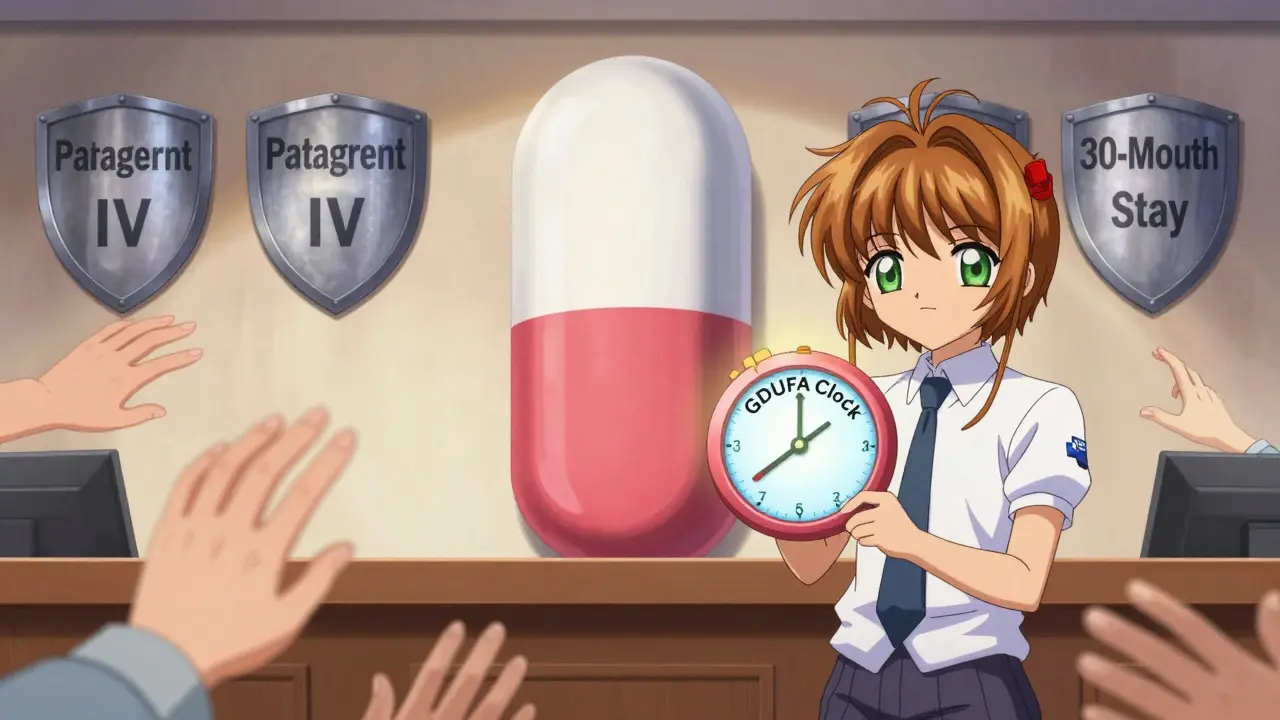
One of the most misunderstood parts of the process is patent law. The Hatch-Waxman Act lets generic companies challenge brand-name patents. If a generic maker files a Paragraph IV certification a legal statement that the brand’s patent is invalid or won’t be infringed, the brand company has 45 days to sue. If they do, the FDA can’t approve the generic for 30 months - even if the application is scientifically perfect.
This 30-month stay is a double-edged sword. It protects innovation, but it also delays access to cheaper drugs. Some companies use multiple patents on minor changes - like a new coating or packaging - to stretch out exclusivity. The FDA calls this "patent thickets." It’s a legal tactic, not a scientific one. In 2022, over 40% of first-generic approvals were delayed by patent litigation. The agency has started pushing back, especially for drugs critical to public health - like naloxone or insulin - where delays cost lives.
Speed, Fees, and the GDUFA System
Before 2012, the FDA had no formal timeline for reviewing generics. Applications piled up. Now, under the Generic Drug User Fee Amendments a funding system where generic companies pay fees to support faster reviews, there are clear deadlines. Standard ANDAs must be reviewed within 10 months. Priority applications - like drugs in shortage or first generics - get reviewed in 8 months. This is a huge improvement from the 180-day goal set in 1984, which was rarely met.
These user fees fund more reviewers, better technology, and clearer guidance. The result? First-cycle approval rates have jumped from 35% in 2012 to over 60% today. That means fewer back-and-forth requests, faster market entry, and lower costs for patients.
Complex Generics: The New Frontier
Not all drugs are created equal. Simple pills? Easy to copy. Inhalers, injectable suspensions, topical creams, and extended-release tablets? Much harder. These are called complex generics drugs where the delivery system is as important as the active ingredient. For these, bioequivalence alone isn’t enough. The FDA needs additional data - like how the drug behaves in the lung, how it’s absorbed through the skin, or how the tablet breaks down over time.
That’s why the FDA launched its Complex Generic Drug Product Development Resources a program to help manufacturers understand how to prove equivalence for tricky products. In 2023, the agency approved its first generic of Vivitrol, a long-acting injectable for opioid addiction. It took over five years of back-and-forth. That’s not a failure - it’s progress. The FDA is learning how to evaluate these products without compromising safety.
Why This Matters to You
Every time you pick up a generic pill and pay $4 instead of $400, you’re seeing the Hatch-Waxman Act in action. In 2022, generics saved the U.S. healthcare system over $370 billion. That’s not a guess. That’s an official FDA estimate. Without this system, millions of people couldn’t afford insulin, heart medications, or antidepressants.
But the system isn’t perfect. Some companies still game the patent system. Some facilities still cut corners. The FDA is underfunded compared to the volume of applications it handles. And complex generics? They’re still a bottleneck.
That’s why the FDA’s new pilot program, announced in October 2025, matters. It gives faster review priority to companies that make their drugs in the U.S. This isn’t just about patriotism - it’s about supply chain resilience. After the pandemic showed how fragile global drug manufacturing can be, the U.S. is trying to bring more production home. If you’re a patient, this means fewer shortages. If you’re a manufacturer, it means a better shot at approval.
What’s Next for Generics?
The future of generics isn’t just about copying old drugs. It’s about making better ones. The FDA is investing in tools to evaluate biosimilars - complex biologic drugs that mimic biotech products like Humira or Enbrel. These aren’t covered by the ANDA pathway; they follow a different, more complex rulebook under the BPCIA. But the same goal applies: more access, lower cost, same safety.
For now, the ANDA system remains the backbone of affordable medicine in America. It’s not flashy. It’s not glamorous. But it works. Every day, thousands of people get the drugs they need because this system - built on science, law, and oversight - lets them.
Are generic drugs as safe as brand-name drugs?
Yes. The FDA requires that generic drugs contain the same active ingredient, strength, dosage form, and route of administration as the brand-name version. They must also prove bioequivalence - meaning they deliver the same amount of medicine into the bloodstream at the same rate. The FDA inspects manufacturing sites for generics just as rigorously as those for brand-name drugs. There is no difference in safety or effectiveness between FDA-approved generics and their brand-name counterparts.
Why do some generics cost more than others?
Price differences between generics come down to competition and supply. When only one company makes a generic, prices stay high. Once a second or third manufacturer enters the market, prices drop sharply - sometimes by 80% or more. Other factors include manufacturing complexity, raw material costs, and whether the drug is in short supply. A simple pill like atorvastatin costs pennies because dozens of companies make it. A complex injectable might cost more because only a few manufacturers can produce it reliably.
Can a generic drug be approved without testing on humans?
No. All generics must demonstrate bioequivalence through clinical studies in healthy volunteers. The FDA does not allow approval based on theoretical models or lab data alone. These studies involve 24 to 36 participants who take both the brand and generic versions under controlled conditions. Blood samples are taken over time to measure how quickly and completely the drug is absorbed. Without this data, the application will be rejected.
What happens if the FDA refuses to accept an ANDA?
If an ANDA is incomplete or doesn’t meet basic requirements, the FDA issues a Refuse-to-Receive (RTR) letter. This means the application is not even reviewed scientifically - it’s returned without evaluation. Common reasons include missing bioequivalence data, incorrect labeling, or incomplete facility information. The company must fix the issues, pay a new filing fee, and resubmit. This can delay approval by months or even years.
Do all generic drugs come from overseas?
No. While a large portion of generic manufacturing happens outside the U.S., over 40% of generic drugs sold in the U.S. are made in American facilities. The FDA inspects both domestic and foreign plants to the same standards. In 2025, the agency began prioritizing applications from companies that manufacture in the U.S. to strengthen domestic supply chains. This means more U.S.-made generics are expected in the coming years.
Bryan Woody
The FDA's ANDA system is one of the few things in American bureaucracy that actually works like it's supposed to
90% of prescriptions filled are generics and not a single one has caused a mass poisoning event because someone cut corners
Yeah I know some sketchy plants in India get inspected once every 3 years but guess what the FDA shuts them down when they catch them
And if you think brand names are safer you're either rich or stupid
Every time I fill my blood pressure med for $4 instead of $400 I thank Hatch-Waxman and the FDA scientists who actually care about patients not shareholders
Timothy Olcott
USA FIRST!!
Why the hell are we letting China and India make our meds??
My grandma got her insulin from a plant in Bangalore and now she's on dialysis 😭
Someone needs to burn down those foreign factories and bring production home
MAKE GENERICS GREAT AGAIN 🇺🇸🔥
Desiree LaPointe
Oh how quaint
You think bioequivalence is some kind of scientific miracle
It's just math dressed up in white coats
80-125% window? That's not precision
That's a 45% swing in systemic exposure
And you call that safe?
Let me guess you also think the placebo effect is just 'psychology'
Meanwhile real medicine requires controlled trials with real patients not 36 college kids on a treadmill with IVs
And don't get me started on the 'same labeling' requirement
It's not the same if the pill is shaped differently and tastes like chalk
But sure keep pretending this is science
It's regulatory theater with a side of profit
Jackie Tucker
There's something profoundly tragic about how we've reduced life-saving medication to a spreadsheet
Each ANDA submission is a 500-page existential crisis
Each bioequivalence study a ritual performed for the altar of cost-efficiency
And we call this progress?
We've turned the human body into a pharmacokinetic model
And the FDA? The high priest of quantified compromise
They don't cure disease
They optimize distribution
And we applaud them for it
While millions still ration pills because the system won't let them afford even the $4 version
It's not broken
It was designed this way
Thomas Jensen
Did you know the FDA gets paid by the drug companies they regulate?
That's why they approve junk
They're in bed with Big Pharma
And the 'inspections'? They're fake
They send inspectors who are former pharma execs
They get drunk at the plant party and sign off
And now they're pushing 'U.S.-made' generics?
Yeah right
It's all a scam to get you to pay more
Meanwhile your insulin is made in a lab in Bangalore that got a 2-hour visit from a guy who took a selfie with the manager
Wake up sheeple
The system is rigged
Allison Priole
I used to be really skeptical about generics
Thought they were just cheap knockoffs
But after my doctor switched me to generic sertraline and I didn't turn into a zombie or lose my mind
I started paying attention
Turns out the FDA actually does its job
And the fact that we're approving complex injectables like Vivitrol after 5 years of back and forth?
That's not failure
That's dedication
It's slow
It's messy
But it's working
And honestly? That's more than I can say for most things in this country
Keep doing the work
Even if no one's cheering
You're saving lives
Casey Tenney
Patent thickets are theft
30-month delays on life-saving drugs?
That's not innovation
That's murder by bureaucracy
And the FDA lets them get away with it
For profit
For shareholders
For lawyers
Not for patients
Someone needs to burn down the patent office
And I'm not joking
Sandy Wells
The entire system is predicated on the assumption that bioequivalence is sufficient
It ignores interpatient variability
It ignores pharmacogenomics
It ignores the fact that some people metabolize drugs differently
And yet we treat all generics as interchangeable
That's not science
That's convenience
And when someone has an adverse reaction because their body responds differently to the filler in a generic tablet
Who takes responsibility?
No one
Because the system was never meant to be personal
It was meant to be efficient