
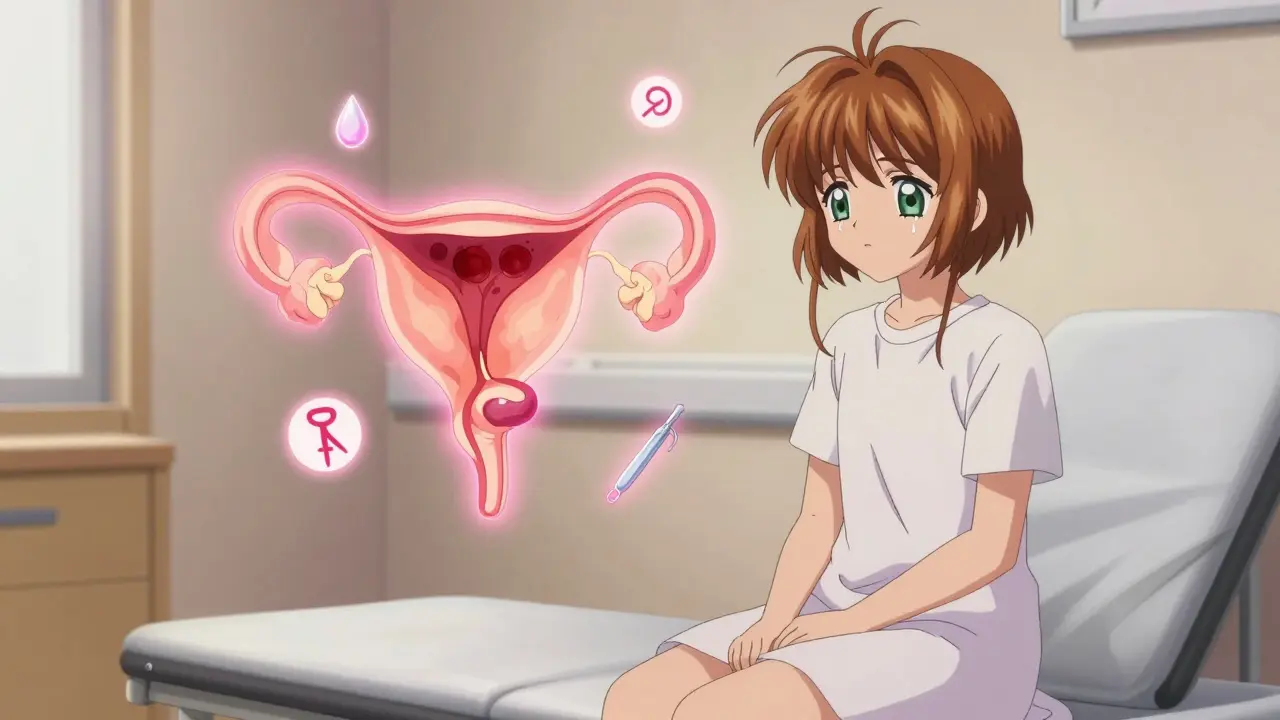
For many women, pelvic pain isn’t just a bad day-it’s a constant, grinding reality that no one seems to take seriously. You go to the doctor with burning urination, constant pressure in your lower belly, pain during sex, and cramps that don’t match your cycle. They tell you it’s a UTI. Then it’s stress. Then it’s just "your body being sensitive." But after months-or years-of being dismissed, you start to wonder: is this normal? Or is something deeper going on?
The truth is, you’re not imagining it. Two conditions-endometriosis and interstitial cystitis-are behind a huge chunk of chronic pelvic pain in women, and they often show up together. In fact, studies show that 65% of women with chronic pelvic pain have both. Yet most doctors still look for one or the other, not both. That’s why so many women get stuck in a loop of misdiagnosis, ineffective treatments, and years of suffering.
What Is Endometriosis, Really?
Endometriosis isn’t just bad periods. It’s tissue similar to the lining of your uterus growing outside the uterus-on your ovaries, fallopian tubes, bowel, bladder, even your diaphragm. This tissue still responds to hormones, so it bleeds and swells each month. But unlike the lining inside your uterus, this blood has nowhere to go. It causes inflammation, scarring, and adhesions that stick organs together. That’s where the pain comes from.
The symptoms are unmistakable if you know what to look for:
- Severe cramping that starts before your period and lasts days
- Pain during or after sex
- Pain with bowel movements or urination, especially during your period
- Heavy bleeding or clotting
- Fatigue, bloating, nausea-especially around your cycle
Here’s the kicker: 92% of women with endometriosis have pain that worsens during menstruation. If your pain follows your cycle like clockwork, that’s a strong signal. But here’s what most doctors miss: endometriosis can also affect the bladder. In 1-12% of cases, lesions grow directly on or into the bladder wall. That’s when you start getting urinary symptoms that feel exactly like interstitial cystitis.
The only way to confirm endometriosis? Surgery. Laparoscopic excision-where a surgeon cuts out the lesions-is the gold standard. Biopsies confirm it. No blood test, no ultrasound, no MRI can definitively rule it in or out. And that’s a problem. The procedure costs $5,000-$15,000 in the U.S., takes weeks to recover from, and only about 15% of OB/GYNs are trained to do it properly. Most are taught to just burn the lesions, not remove them completely. That’s why pain comes back.
What Is Interstitial Cystitis?
Interstitial cystitis (IC), also called painful bladder syndrome, is a chronic condition where your bladder becomes inflamed without infection. No bacteria. No cancer. No stones. Just pain. The bladder wall gets irritated, stiffens, and loses its ability to stretch. That means you feel the urge to go all the time-even when your bladder isn’t full.
IC doesn’t follow your cycle. It doesn’t care if it’s Monday or the day before your period. The pain is constant, though it can flare up with stress, certain foods, or sex. Common signs:
- Urinating more than 7 times a day
- Waking up at night to pee (nocturia)
- Burning or pressure in the bladder or pelvis
- Pain that gets worse as your bladder fills
- Pain during or after sex
There’s no single test for IC. Doctors have to rule out everything else first: UTIs, kidney stones, bladder cancer, sexually transmitted infections. That’s why diagnosis takes an average of 3-5 years. The tools they use aren’t perfect. A potassium sensitivity test (PST) checks how your bladder reacts to a potassium solution. If it hurts badly, IC is likely. But it has a 20% false negative rate. Cystoscopy-a camera inserted into your bladder-can show Hunner’s lesions (ulcers), which are a clear sign of IC. But not everyone with IC has those.
And here’s the twist: your bladder capacity drops. A normal bladder holds 400-600 mL. Someone with IC? Often 300-400 mL, sometimes less. The pain hits at much lower volumes. That’s why you’re constantly running to the bathroom.
Why These Two Conditions Look the Same
Endometriosis and IC share so many symptoms it’s easy to see why they’re called the “evil twins.” Both cause:
- Chronic pelvic pain (100% of cases)
- Urinary urgency and frequency
- Dysuria (painful urination)
- Dyspareunia (pain during sex)
But the differences matter. Endometriosis pain is cyclical-it spikes with your period. IC pain? It’s more constant. If your pain flares only during your period, endometriosis is more likely. If your pain stays the same all month, IC is the bigger suspect.
One key clue: blood in the urine. It’s rare in pure IC-under 5% of cases. But in bladder endometriosis, it shows up in 20-30% of patients. If you’ve ever seen pink or red in your urine during your period, that’s a red flag for endometriosis affecting your bladder.
And here’s what most doctors don’t tell you: up to 80% of women diagnosed with IC actually have undiagnosed endometriosis. That’s not a guess. It’s from a 2022 interview with Dr. Robert Moldwin, a top urologist. He’s seen it over and over: women get treated for IC for years-diet changes, bladder instillations, medications-only to find out during laparoscopy that endometriosis was the real culprit.
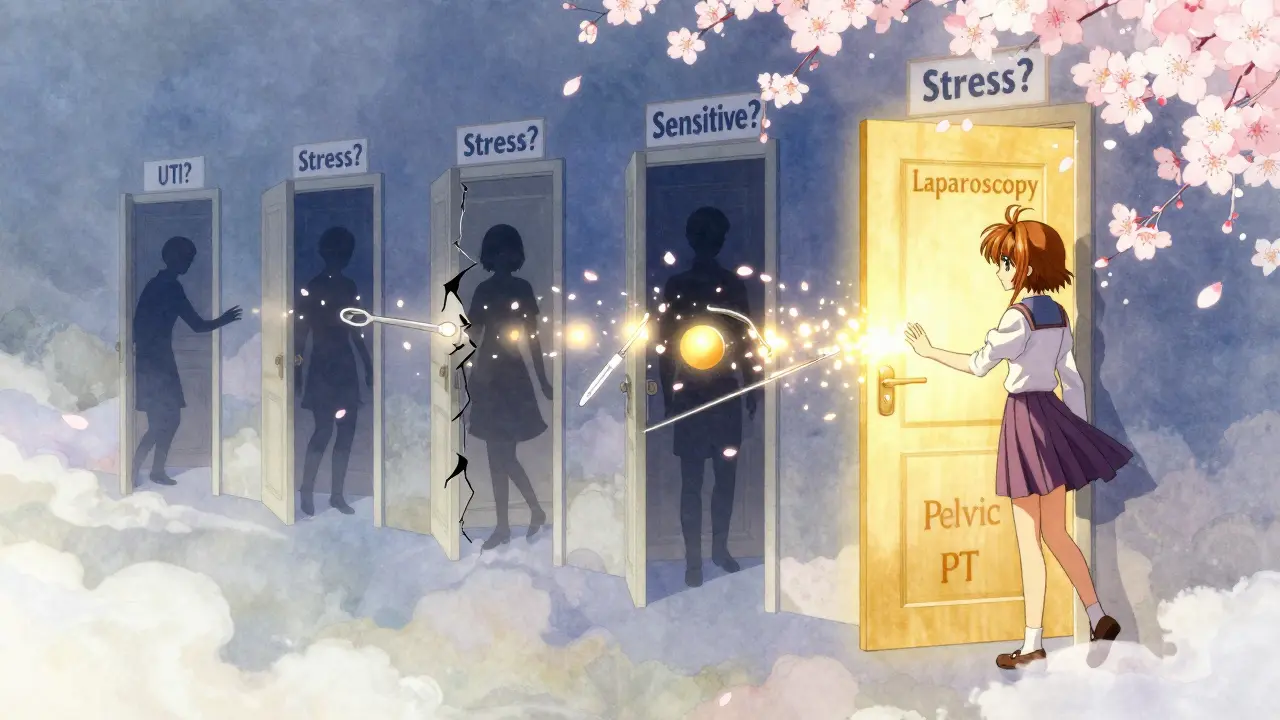
The Real Problem: Diagnosis Takes Too Long
On average, women wait 7-10 years to get a correct endometriosis diagnosis. For IC, it’s 3-5 years. Why so long?
- Doctors don’t link pelvic pain to endometriosis unless you’re having fertility issues.
- IC is a diagnosis of exclusion-you have to rule out 12+ other conditions first.
- Many providers don’t know how to do a proper pelvic exam for endometriosis.
- Insurance denies cystoscopies and laparoscopies. One survey found 44% of patients were initially denied coverage.
- Medical gaslighting is rampant. 76% of IC patients say they were told their pain was "all in their head."
Reddit threads are full of stories like this: one woman, u/PelvicPainWarrior, was diagnosed with IC for 9 years. Her third laparoscopy revealed stage IV endometriosis on her bladder wall. After surgery, her urinary symptoms dropped by 80%. Another user, u/BladderWarrior, had been on Elmiron (the only FDA-approved IC drug) for years-until she found out her pain was from endometriosis. After excision, she stopped taking it.
And here’s the heartbreaking part: 68% of women surveyed by the Endometriosis Foundation were diagnosed with IC before endometriosis. That means they were treated for the wrong thing. Antibiotics for fake UTIs. Bladder instillations that didn’t touch the real problem. Painkillers that just masked symptoms.
What Happens When You Have Both?
When endometriosis and IC show up together-which they often do-it’s not a coincidence. It’s a cascade. Endometriosis lesions on the bladder cause inflammation. That inflammation irritates the bladder wall, triggering IC-like symptoms. The bladder gets hypersensitive. The pelvic floor muscles tighten up in response. That’s why 92% of women with either condition have pelvic floor dysfunction.
Pelvic floor muscles are like a hammock holding your bladder, uterus, and rectum. When they’re constantly tense from pain, they become tight, weak, and painful themselves. That’s why physical therapy is often the missing piece. A pelvic floor therapist can teach you how to relax those muscles, which can reduce pain even before surgery.
Combined treatment works. A 2022 review of 342 patients showed that 63% saw major improvement when they got both endometriosis excision surgery and IC management (diet, physical therapy, bladder training). One woman told HealthUnlocked: "After surgery, my IC meds were cut in half. I didn’t need them anymore."

How to Get the Right Diagnosis
If you’re suffering, here’s what to do:
- Keep a symptom diary for 3 weeks. Note pain levels, urination frequency, menstrual cycle, food triggers, and sex-related pain.
- Ask for a pelvic exam by a specialist trained in endometriosis. General OB/GYNs often miss deep lesions.
- Request a cystoscopy and PST if IC is suspected. Insist on ruling out UTIs with cultures, not just dipsticks.
- Insist on laparoscopy if you have cyclical pain, especially with urinary symptoms. Don’t accept "it’s just IC" without ruling out endometriosis.
- Find a urogynecologist or endometriosis excision specialist. There are only about 350 board-certified urogynecologists in the U.S. Use the Endometriosis Foundation’s provider directory.
- Start pelvic floor physical therapy now. It helps regardless of the final diagnosis.
And if your insurance denies a test? Appeal. Document everything. Bring peer-reviewed studies to your appointment. The 2023 International Pelvic Pain Society now recommends simultaneous gynecological and urological evaluation for chronic pelvic pain. That’s the standard you should demand.
What’s Next?
The field is changing. In February 2024, the NIH gave $4.2 million to the University of Michigan to find biomarkers that can tell endometriosis and IC apart with a blood or urine test. The Endometriosis Foundation now requires bladder evaluation during every excision surgery. By 2030, experts predict multidisciplinary pelvic pain centers will be the norm-not the exception.
But you don’t have to wait for the system to catch up. You can start now. Get the right tests. Find the right specialist. Don’t let anyone tell you it’s normal to live in pain. You’re not alone. And you’re not imagining it. Your pain is real. And there’s a path forward.
kenneth pillet
Been there. Diagnosed with IC in 2019. Turned out it was endometriosis on my bladder wall. Surgery fixed 90% of the urinary stuff. No more midnight runs to the bathroom. Doctors just don't look beyond the obvious.
Naomi Keyes
Let me be perfectly clear: the 65% co-occurrence statistic is not merely coincidental-it is pathophysiologically significant, and the medical community’s continued failure to adopt simultaneous diagnostic protocols is a systemic failure of both training and institutional inertia. Furthermore, the assertion that ‘no blood test exists’ is outdated; emerging biomarkers such as miR-200c and CA-125 variants show promise in preliminary cohorts (see: J Reprod Med 2023;68(4):211–220). Why are we still relying on invasive surgery as the gold standard when non-invasive alternatives are in Phase III trials?
Jake Moore
My sister went through 8 years of this. She finally found a urogynecologist in Chicago who did the full combo: cystoscopy + laparoscopy + pelvic floor PT. Now she’s pain-free and actually sleeping through the night. You’re not crazy. You just need the right team.
Emma #########
I just want to say thank you for writing this. I felt so alone until I read this. I’ve been told I’m ‘too sensitive’ so many times I started doubting myself. But this? This is what I’ve been living. I’m not broken. I just need someone to listen.
Jay Clarke
Oh here we go again. Another ‘women’s pain is real’ sob story. Newsflash: men get chronic pain too. But we don’t get a free pass because we have a uterus. Stop treating women like fragile porcelain dolls. Maybe if you stopped obsessing over every twinge, you’d feel better. Just sayin’.
Andrew Short
Wow. So now we’re supposed to believe that 80% of IC patients have hidden endometriosis? That’s not science-that’s a sales pitch from some $15k surgery clinic. Where’s the double-blind RCT? Where’s the control group? This reads like a sponsored post for excision surgeons. Wake up, people.
Danny Gray
Is it possible that pain is just… a signal? Not a disease? Maybe we’ve pathologized normal biological variation. The body isn’t a machine to be fixed-it’s a process to be understood. You’re not broken. You’re communicating. Maybe the real issue is our refusal to listen without a scalpel.
Nishant Sonuley
Bro, I’m from India and we don’t even have access to laparoscopy in most towns. My cousin had pelvic pain for 11 years. They gave her paracetamol and told her to ‘do yoga’. Meanwhile, in the US you’ve got specialists, NIH funding, Reddit threads… I’m jealous. But also… why does it take 7 years to diagnose something that’s clearly in the literature? Is it the gender? The cost? The laziness? All of the above?
Chuck Dickson
You’re not alone. Seriously. I’ve seen women go from crying in waiting rooms to running marathons after proper treatment. It’s not magic-it’s persistence. Find a specialist. Keep a diary. Bring printouts to your appointment. You’re not being difficult-you’re being brave. Keep going. Your body deserves to be heard.
Dayanara Villafuerte
OMG YES. I had IC for 6 years. Then found out I had endo on my bladder. After surgery? No more Elmiron. No more midnight bathroom trips. 🙌 I’m alive again. Also, pelvic PT changed my life. Find a therapist who knows what they’re doing. Don’t settle for ‘just relax’ 💪❤️
Jodi Harding
They told me it was stress. I was 22. Now I’m 31. I’ve had 3 surgeries. I still can’t sit through a movie. This isn’t a diagnosis. It’s a life sentence.
Eric Gebeke
Everyone’s so quick to blame the doctors. But what about the patients? You’re the ones who let them dismiss you. You didn’t push hard enough. You didn’t bring research. You didn’t demand second opinions. You waited. And now you’re surprised? Wake up. You have agency. Use it.
Zoe Brooks
I started pelvic floor PT last month. Honestly? I thought it was a scam. But after 4 sessions, my bladder doesn’t feel like it’s about to explode anymore. It’s not a cure-but it’s a reprieve. And sometimes, that’s enough to keep going.
Andrew McLarren
It is imperative that the medical establishment adopt a multidisciplinary paradigm for the evaluation of chronic pelvic pain, as recommended by the International Pelvic Pain Society in 2023. The current siloed approach-where gynecologists, urologists, and physical therapists operate in isolation-is not merely inefficient; it is ethically indefensible. The convergence of diagnostic criteria, standardized referral pathways, and insurance reform must be prioritized at institutional, legislative, and academic levels.