

Dark spots on your face that won’t go away? You’re not alone. Millions of people deal with hyperpigmentation every day, but not all dark spots are the same. What looks like a simple sunspot might actually be melasma - a stubborn condition that responds to completely different treatments. Mixing them up can make things worse, not better.
What’s Really Causing Your Dark Patches?
Hyperpigmentation means your skin is making too much melanin - the pigment that gives skin its color. But why? Two common culprits are melasma and sun damage, and they’re often confused because they look similar: brown or gray-brown patches on the face.
Sun damage, or solar lentigines, shows up as small, defined spots on areas hit by the sun - cheeks, nose, hands, shoulders. These develop slowly over years of UV exposure. By age 60, about 90% of fair-skinned people have them. They’re predictable. If you treat them right, they fade.
Melasma is different. It’s not just about the sun. It’s hormonal. You’re more likely to get it if you’re a woman, especially between 20 and 50, and if you have medium to dark skin (Fitzpatrick types III-VI). It shows up as large, blurry patches on the cheeks, forehead, upper lip, or chin. Pregnancy, birth control pills, and hormone therapy can trigger it. Heat and even visible light from screens or windows can make it worse. It’s not just a sun problem - it’s a system problem.
Why Sunscreen Alone Isn’t Enough
Most people think SPF 30 is enough. It’s not - not for melasma. Standard sunscreens block UV rays, but melasma is also triggered by visible light and infrared radiation. That means regular sunscreen doesn’t stop the full problem.
Harvard Health reports that up to 30% of melasma cases are worsened by visible light alone. That’s why dermatologists now recommend mineral sunscreens with iron oxides - they block more than just UV. Zinc oxide and titanium dioxide help, but iron oxides are the key. Look for tinted sunscreens. They’re not just for coverage - they’re medical-grade protection.
And yes, you need it indoors. Visible light passes through windows. If you sit near a sunny window all day, you’re feeding your melasma. Daily sunscreen isn’t optional - it’s the foundation of every treatment plan.
Topical Treatments That Actually Work
There’s no magic cream, but there are proven combinations. The most effective topical treatment for melasma is a triple combination: hydroquinone, tretinoin, and a corticosteroid. This isn’t a one-size-fits-all fix - it’s a carefully balanced approach.
Hydroquinone (4%) is the gold standard. It blocks the enzyme that makes melanin. It works fast - most people see improvement in 8-12 weeks. But there’s a catch: long-term use can cause ochronosis, a rare but irreversible blue-black discoloration. That’s why it’s limited to 3-6 months at a time.
Tretinoin (0.025-0.1%) speeds up skin turnover. It pushes out the dark pigment faster. It also makes hydroquinone work better. But it irritates skin. Start slow - every other night. Build up over weeks.
Vitamin C (10-20% L-ascorbic acid) is a gentle but powerful ally. It’s an antioxidant that fades existing pigment and stops new melanin from forming. Use it in the morning under sunscreen. It’s safe for long-term use and works well with other treatments.
For those who can’t use hydroquinone - due to side effects or regional restrictions - alternatives like tranexamic acid (5%) and kojic acid are gaining traction. Tranexamic acid, originally a blood thinner, reduces pigment production when applied topically. Studies show 45% improvement in melasma after 12 weeks with minimal irritation.
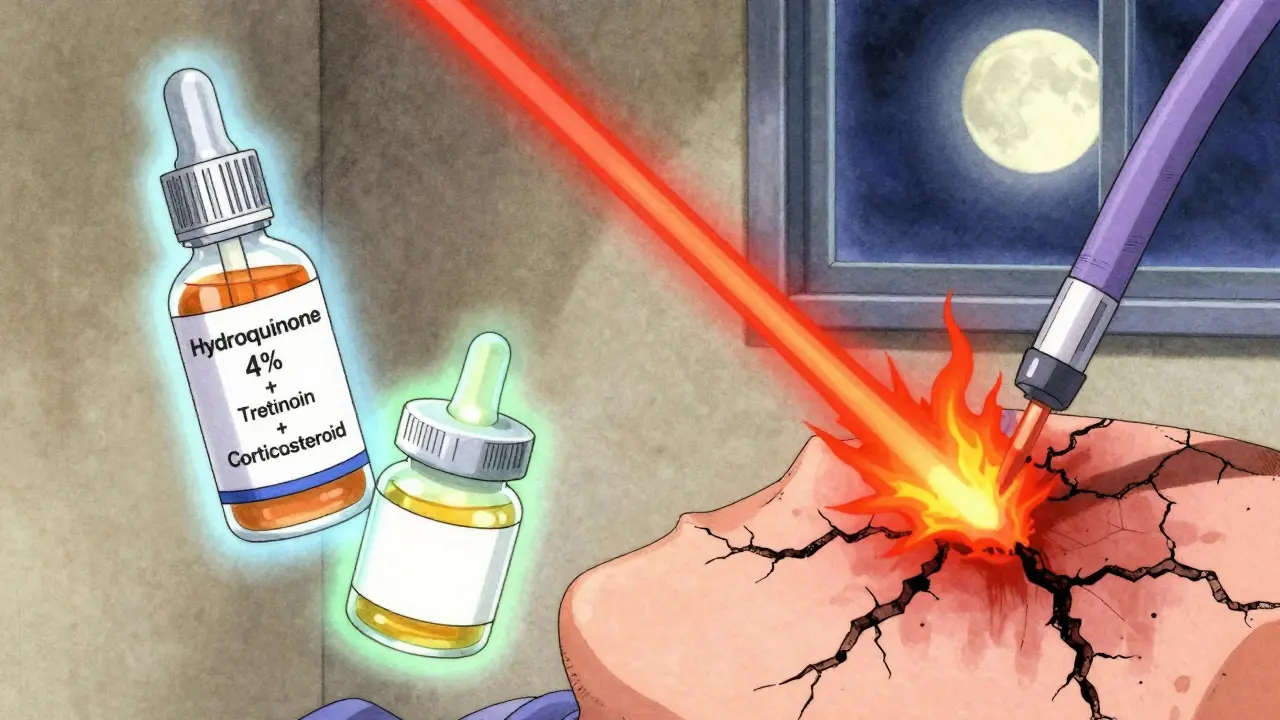
Laser and Light Treatments: When They Help - and When They Hurt
Lasers and IPL (Intense Pulsed Light) work great for sun damage. They target the dark spots, heat them up, and the skin sheds them in days. Most people need just one or two sessions.
But for melasma? It’s risky. Heat triggers melanocytes - the pigment cells - and can make melasma darker and more widespread. Studies show a 30-40% chance of worsening melasma after IPL. That’s why dermatologists won’t even consider lasers until the skin is calm and the pigment is suppressed with topicals for 8-12 weeks.
Even then, it’s not a cure. Melasma comes back. That’s why lasers are used as a finishing tool - not a first step. The goal isn’t to erase the pigment overnight. It’s to manage it long-term.
The Real Reason Treatments Fail
Most people give up too soon. Melasma doesn’t vanish in two weeks. It takes 3-6 months of consistent care to see real change. And even then, 80% of people see it return within a year if they stop sun protection.
The biggest mistake? Under-applying sunscreen. Most people use only 1/4 of the amount they need. You need about 1/4 teaspoon just for your face. And you have to reapply every two hours if you’re outside. No exceptions.
Another common error: using too many products at once. Layering hydroquinone, retinoids, acids, and exfoliants can burn your skin. Irritation triggers more pigmentation - especially in darker skin tones. Start slow. One active at a time. Let your skin adjust.
And don’t skip the dermatologist. Over-the-counter products often contain too little of the active ingredients to matter. A prescription-grade regimen is the only way to get real results.
Who Gets Melasma - And Why It’s Not Just a ‘Beauty Issue’
Melasma affects Black, Asian, and Hispanic women 3-5 times more often than Caucasian women. It’s not vanity - it’s biology. Hormones, skin type, and UV exposure all play a role. For many, it’s tied to pregnancy (called the “mask of pregnancy”) or birth control.
It’s also emotionally heavy. People with melasma report lower self-esteem, anxiety, and even depression. It’s not just a cosmetic concern - it impacts daily life.
That’s why treatment isn’t just about creams and lasers. It’s about education, support, and realistic expectations. You won’t get flawless skin. But you can get significant improvement - and keep it stable.

What’s Next in Hyperpigmentation Treatment
The field is evolving. In 2022, the FDA proposed reclassifying hydroquinone as an over-the-counter drug with strict safety labeling. That could make it more accessible - but also riskier if misused.
New agents like cysteamine cream (10%) are showing promise in clinical trials. It’s less irritating than hydroquinone and works by breaking down melanin directly. Early results show 60% improvement in melasma after 16 weeks.
Researchers are also exploring genetic testing to predict who responds best to which treatment. Within five years, your treatment might be tailored based on your DNA - not trial and error.
For now, the best advice is simple: protect your skin every day, use proven topicals consistently, and don’t rush into lasers. Melasma is a marathon, not a sprint.
Realistic Expectations
Don’t expect perfection. Even with perfect care, melasma improves by 40-60% in six months. Sun damage? 75-90% improvement in two to three months. That’s the difference.
Success means fewer patches, lighter color, and longer breaks between flare-ups. It’s about control, not cure.
And remember - your skin remembers. One missed sunscreen day can undo weeks of progress. That’s why consistency beats intensity every time.
Can melasma go away on its own?
Sometimes - but rarely. Melasma triggered by pregnancy often fades after delivery, especially if sun exposure is minimized. But for most people, especially those using hormonal birth control or with chronic sun exposure, melasma doesn’t disappear without treatment. Without ongoing care, it usually returns within months.
Is hydroquinone safe for long-term use?
No. Hydroquinone is effective for short-term use - typically 3 to 6 months. After that, the risk of ochronosis (a dark, irreversible discoloration) increases. Dermatologists recommend cycling it: use for 3 months, take a 2-month break, then restart if needed. Never use it daily for more than 6 months without medical supervision.
Can I use vitamin C and retinol together?
Yes - but not at the same time. Use vitamin C in the morning under sunscreen. Use retinol (or tretinoin) at night. Combining them in one routine can irritate your skin and reduce effectiveness. Let each ingredient work on its own.
Why does my melasma get worse in summer?
Sunlight - especially UV and visible light - triggers melanocytes to produce more pigment. Heat also plays a role. In summer, longer days, stronger sun, and higher temperatures all combine to worsen melasma. That’s why strict sun protection is non-negotiable during warmer months.
Are natural remedies like lemon juice or aloe vera effective?
No. Lemon juice is highly acidic and can burn your skin, leading to more pigmentation. Aloe vera soothes irritation but doesn’t reduce melanin. While some natural ingredients like niacinamide or licorice root show mild benefits in studies, they’re not strong enough to replace prescription treatments. Don’t risk irritation for unproven results.
How much does melasma treatment cost?
Prescription topicals like hydroquinone and tretinoin cost $50-$150 per month, depending on insurance. Laser treatments run $300-$600 per session, and you may need multiple. Chemical peels cost $150-$400 each. The most affordable and effective approach is consistent topical therapy combined with sunscreen - which costs under $30 a month.
Can men get melasma?
Yes - but it’s rare. Only about 10% of melasma cases occur in men. When it does, it’s often linked to hormone imbalances, stress, or heavy sun exposure. Men are less likely to use sunscreen or seek treatment early, so melasma in men tends to be more advanced by the time it’s diagnosed.
What’s the difference between melasma and post-inflammatory hyperpigmentation (PIH)?
Melasma appears in symmetrical patches on sun-exposed areas and is hormone-driven. PIH shows up after skin injury - acne, eczema, cuts, or burns - and follows the shape of the original wound. PIH is more common in darker skin tones and gets worse with laser treatments. Treatment for PIH is similar but doesn’t require hormonal management.
Next Steps: What to Do Today
Start with three simple actions:
- Buy a tinted mineral sunscreen with iron oxides (SPF 50+). Apply a quarter teaspoon to your face every morning - even if it’s cloudy.
- Visit a dermatologist. Get a prescription for a triple-combination cream if you have melasma. If you have sun damage, ask about chemical peels or laser options.
- Stop using random OTC brightening creams. Most are too weak to help and may irritate your skin.
Hyperpigmentation isn’t a quick fix. But with the right plan, you can take back control of your skin - one day, one sunscreen application, one consistent night at a time.
Ajay Brahmandam
Been dealing with melasma for years and this is the first time I’ve seen someone explain the difference between sun damage and hormonal patches so clearly. I used to think sunscreen was enough until I started getting patches under my eyes even indoors. Iron oxide tinted sunscreens changed everything for me. No more hiding behind makeup.
Cara Hritz
i think u r wrong about hydroquinone its actually safe if u use it right like every other day and dont go in the sun like at all also i heard the fda is gonna ban it next year so get it while u can lol
jenny guachamboza
⚠️⚠️⚠️ THIS IS A BIG PHARMA TRAP. 🤫 They want you to buy expensive creams so you don’t find out melasma is caused by 5G towers and fluoride in the water. 🌐💧 I’ve had it for 8 years and stopped using sunscreen - guess what? It got lighter. Coincidence? I think not. 🌞❌
Kiranjit Kaur
YESSSS this is so true!! 🙌 I had melasma after my second baby and thought it’d fade on its own… nope. Started using vitamin C + tinted SPF with iron oxides and my skin finally feels like mine again. No lasers, no drama. Just consistency. You got this, girls 💪✨
Jamison Kissh
There’s a deeper philosophical layer here - hyperpigmentation as a metaphor for accumulated trauma. The skin remembers what the mind tries to forget. Melasma isn’t just pigment; it’s the body’s archive of hormonal shifts, stress, and silent suffering. We treat the surface, but the system holds the key. Perhaps the real cure is not in creams, but in peace.
Tarun Sharma
The distinction between melasma and solar lentigines is clinically significant and often overlooked. Consistent use of broad-spectrum mineral sunscreen with iron oxides is non-negotiable in management protocols. Topical triple therapy remains the most evidence-based approach for moderate to severe cases.
Art Van Gelder
Let me tell you - I used to think I was just getting old. Sun spots, right? Then I went to a dermatologist in Austin and she looked at me like I’d just said the moon landing was fake. "This isn’t sun damage," she said. "This is your hormones screaming at you." And she was right. I’m 42, on birth control, work by a window, and I never wore sunscreen indoors. Turns out, my laptop screen was literally darkening my face. I started using that tinted SPF with iron oxide - the one that looks like a tinted moisturizer but costs $38 - and within six weeks, the patches on my cheeks went from "I need foundation" to "I can go makeup-free." I still reapply every two hours like my skin depends on it. Because it does. And yeah, I cry sometimes when I see my reflection without makeup. Not because I’m insecure - because I finally feel like I’m not fighting a losing battle.
Nader Bsyouni
Everyone’s obsessed with hydroquinone like it’s some holy grail but have you considered that maybe melanin isn’t the enemy Maybe we’re pathologizing natural skin variation for profit And what about the fact that most studies are funded by cosmetic giants who sell the very creams they claim work
Johnnie R. Bailey
In India, we have a long tradition of using turmeric and sandalwood for skin - not because they cure melasma, but because they’re gentle. Modern science confirms what Ayurveda knew: irritation worsens pigmentation. That’s why I always tell my patients: start slow, protect relentlessly, and don’t let marketing push you into aggressive treatments. Your skin isn’t a battlefield - it’s a garden. You don’t burn weeds to make roses grow.
Jim Brown
One might argue that the obsession with eradicating hyperpigmentation reflects a deeper cultural pathology - the infantilization of the skin as an object of perfection rather than a living chronicle of lived experience. Melasma, in its stubborn persistence, is not a flaw to be corrected, but a silent testament to hormonal autonomy, to the biological weight carried by women across generations. To treat it is not merely to lighten pigment, but to negotiate the terms of visibility in a world that demands flawless surfaces. Perhaps the most radical act is not the application of iron oxide, but the refusal to apologize for the skin one has been given.