

When you pick up a compounded medication, you might notice a date printed on the label that says beyond-use date-not expiration date. That’s not a typo. It’s a critical difference, and misunderstanding it can put your health at risk. Unlike pills you buy at a chain pharmacy, compounded medications aren’t mass-produced. They’re made in small batches, tailored to your needs-maybe you’re allergic to a dye, need a different strength, or can’t swallow tablets. But because they’re custom-made, they don’t go through the same stability tests as FDA-approved drugs. That’s why the beyond-use date (BUD) exists: to tell you exactly when the medication might no longer be safe or effective.
What Exactly Is a Beyond-Use Date?
A beyond-use date isn’t just a suggestion. It’s a hard cutoff. According to USP Chapter <797>, the BUD is the date after which a compounded preparation must not be used. This date is calculated from the day the medication was mixed, not when you got it. The goal? To prevent you from taking something that’s degraded, contaminated, or lost potency.
Think of it this way: a bottle of ibuprofen from the drugstore has an expiration date stamped by the manufacturer after years of testing under controlled conditions. A compounded liquid pain reliever? No such luxury. It could be mixed in a small lab with no industrial-grade controls. That’s why the BUD is often much shorter-sometimes just hours or days.
Why BUDs Are Different from Expiration Dates
The biggest confusion comes from treating BUDs like expiration dates. They’re not the same. Expiration dates apply to FDA-approved drugs that have been tested for stability over months or years. Compounded medications? They’re evaluated based on real-world conditions: how they were made, what they’re stored in, and how they’re kept.
For example, a commercial injectable antibiotic might last 24 months. But if a pharmacist mixes that same drug into a sugar-based oral suspension for a child who can’t swallow pills, the BUD might drop to 14 days-even if the original drug is still good. Why? Because sugar and water create a perfect environment for bacteria. The container matters too. A glass vial holds stability better than a plastic syringe. And if the medication is stored at room temperature instead of refrigerated? That BUD shrinks even faster.
A 2023 study in the Journal of Pharmacy Practice found that compounded formulations with altered pH levels degraded 3.7 times faster than their commercial counterparts. That’s not a small difference. That’s the difference between a safe dose and a dangerous one.
How Pharmacists Determine BUDs
Assigning a BUD isn’t guesswork. It’s science. Pharmacists follow a strict process based on USP <797> guidelines. Here’s how it works:
- Identify the formulation-every ingredient, concentration, and solvent matters. Even a tiny change in pH or preservative can alter stability.
- Classify the risk level-low, medium, or high. Low-risk means no sterile technique needed (like oral liquids). High-risk means sterile prep, like IV bags. Each has different BUD limits.
- Check manufacturer data-if the active ingredient has published stability info, that’s a starting point.
- Consult validated literature-there are databases with thousands of tested formulations. But only 29.4% of pharmacists use them regularly.
- Test if needed-the gold standard is direct stability testing using HPLC (high-performance liquid chromatography). Only 37.2% of pharmacies do this properly.
Here’s where things go wrong: many pharmacists rely on outdated assumptions. For example, using the BUD of a vial to date a medication stored in a syringe. The FDA explicitly warns that syringes aren’t approved for long-term storage. Yet, 41.3% of retail compounding pharmacies still do it, according to a 2022 survey.
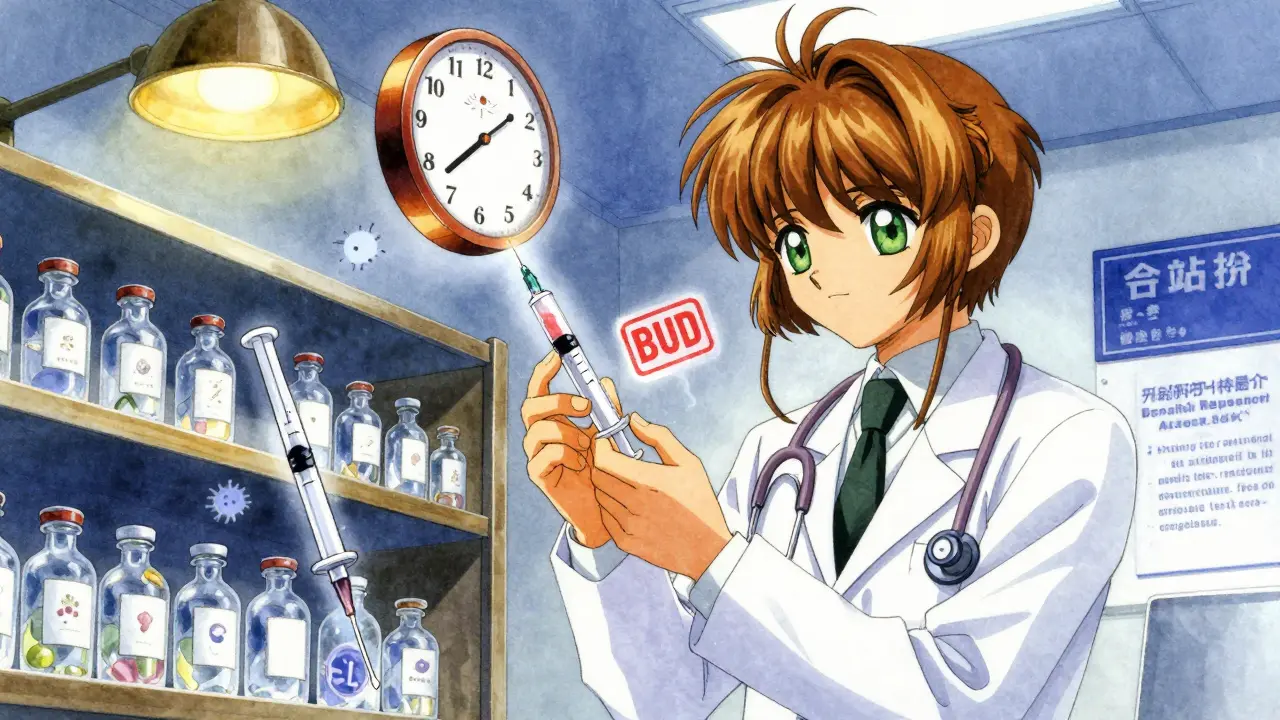
What Happens If You Use a Medication Past Its BUD?
It’s not just about effectiveness. It’s about safety.
Chemical degradation means the drug might break down into toxic byproducts. A 2021 FDA recall pulled over 1,200 compounded sterile products because microbial growth had occurred-patients were at risk of bloodstream infections. Physical changes matter too: a cloudy liquid, crystals forming, or a strange odor are red flags.
Even if the medication looks fine, potency can drop. A study showed that some compounded antibiotics lost over 20% of their strength after just 10 days beyond their BUD. That’s enough to make the treatment fail-leading to longer illness, stronger antibiotics, or worse outcomes.
And it’s not rare. A 2022 analysis in the Journal of the American Pharmacists Association found that 12.7% of medication errors involving compounded drugs were due to incorrect BUD assignment or use beyond the date.
What You Should Do as a Patient
You don’t need to be a pharmacist to protect yourself. Here’s what to do:
- Always check the BUD-it should be clearly printed on the label, along with the date the medication was compounded.
- Ask how the BUD was determined-if the pharmacist can’t explain it, that’s a warning sign.
- Follow storage instructions-if it says refrigerate, keep it cold. If it says protect from light, don’t leave it on the counter.
- Don’t use it past the date-even if it looks fine. That’s not worth the risk.
- Return expired meds-most pharmacies will take back unused compounded medications for safe disposal.
And if you’re unsure? Call the pharmacy. Ask them to explain the BUD. Good pharmacies welcome that question. They know it’s your safety on the line.
Why This Matters More Than Ever
The demand for compounded medications is rising. In 2022, they made up 7.2% of all prescriptions. By 2030, that number is projected to hit 18.3%. Why? More people need personalized treatments-kids who can’t swallow pills, cancer patients needing specific doses, people with rare allergies.
But with more demand comes more pressure. Retail pharmacies are under financial strain. Stability testing costs money. Documentation takes time. That’s why compliance rates are lower in retail pharmacies (76.8%) compared to hospitals (92.4%).
And regulators are catching on. The FDA issued 34.1% more BUD-related citations in 2023 than in 2022. USP is pushing for stricter rules-by 2024, any BUD over 30 days will likely require direct testing. That’s going to change how these meds are made.
Real-time monitoring tools are starting to appear. One system, SmartBUD, cut BUD errors by 47% in a 2023 pilot. That’s promising. But until those tools are everywhere, the burden falls on you to understand what that date means.
Bottom Line: Don’t Guess. Verify.
A beyond-use date isn’t a suggestion. It’s a safety line drawn by science. Compounded medications save lives-but only when they’re handled right. You can’t assume they’re as stable as store-bought pills. You can’t trust a pharmacy that can’t explain their BUD. And you can’t risk using something past its date just because it looks okay.
If you’re taking a compounded medication, treat the BUD like a bomb timer. When it hits zero, it’s time to stop. Not tomorrow. Not when you run out. Right then.
Ask questions. Demand answers. Your health depends on it.
Paige Shipe
The beyond-use date isn't some suggestion from a pharmacist who ran out of coffee. It's a hard scientific boundary, and treating it like a recommendation is how people end up in the ER. I've seen it too many times-patients think 'it still looks fine' means it's safe. That's not how chemistry works.
USP Chapter 795 and 797 exist for a reason. If your compounding pharmacy can't tell you which standard they used to set that date, walk out. No exceptions.
I don't care if it's 'just a liquid.' If it's not sterile and it's sitting at room temp for 30 days, it's a petri dish with a prescription label.
Tamar Dunlop
My heart aches for those who live in regions where access to compounding pharmacies is scarce, and yet the burden of understanding BUDs falls entirely on the patient. In Canada, we have stringent regulations, but even here, rural communities suffer from the same ignorance and complacency.
That 2023 study showing 3.7 times faster degradation? It's not just data-it's a child's fever that won't break, a cancer patient's nausea that returns because the dose is now 20% weaker. We must treat these dates not as bureaucratic footnotes, but as lifelines.
Let us not forget: behind every compounded medication is a human being who cannot take the standard pill. Their vulnerability should be our collective responsibility.
Emma Duquemin
OMG I just had a revelation. I’ve been using my compounded thyroid med past the BUD because ‘it still smells the same’-and now I’m horrified. Thank you for this article, it’s like a wake-up call wrapped in a lab coat.
Did you know that even the color of the bottle matters? Clear plastic? Bad news. Amber glass? Good. I’ve started photographing my meds with the label and date on my phone now. It’s weird, but I’ve saved myself from three near-misses already.
Also-SARCASTIC ALERT-why is it that the same pharmacy that charges $150 for a 30-day supply won’t pay for HPLC testing? Money over safety. Again. I’m done being a guinea pig.
Pro tip: If your pharmacist says ‘it’s fine, I’ve been doing this for 20 years,’ ask them if they’ve ever had a patient get sepsis from their batch. Watch them go silent. I did. They did. I left.
Kevin Lopez
USP 795/797 non-compliance is endemic. 41.3% using syringes for long-term storage? That’s not negligence-it’s malpractice. HPLC validation is the gold standard; if you’re not doing it, you’re gambling with pharmacokinetics. The 2022 JAPhA error rate of 12.7%? Underreported. Real-world data shows closer to 18%.
Storage temp deviations >2°C reduce stability by 30–60%. You’re not ‘saving money’ by skipping testing. You’re creating liability. And patients? They’re the ones paying with their lives.
Samar Khan
So... you're telling me I'm basically a lab rat because I need a dye-free version of my med? 😔
And now I have to be a pharmacist too? 🤦♀️
Why can't Big Pharma just make one version that doesn't kill people with allergies? 😒
My BUD was printed in Comic Sans. I'm not even mad. I'm just... done. 🤷♀️
Russell Thomas
Oh wow, a whole article about dates on medicine. Next you’ll tell me not to drink expired milk.
Let me guess-you’re the kind of person who checks the expiration date on hand sanitizer and cries if it’s 3 days past. Congrats, you’re the FDA’s favorite citizen.
Meanwhile, my grandma takes her compounded meds 2 weeks past the date and still walks 5 miles a day. So… maybe your ‘science’ is just fear marketing?
Also, why is the pharmacist the one who gets to decide? I’ve been taking this stuff for 10 years. I think I know my body better than some guy in a white coat with a calculator.
Joe Kwon
Great breakdown. I work in hospital pharmacy and can confirm: the gap between retail and hospital compliance is staggering. We do HPLC testing on every high-risk compound. It’s expensive, but it’s non-negotiable.
One thing I’d add: BUDs aren’t just about degradation-they’re about sterility assurance. A 14-day BUD on a compounded IV isn’t arbitrary; it’s based on microbial growth curves in the vehicle. Even if the active ingredient is stable, contamination risk spikes after day 10.
Patients: if your pharmacy doesn’t have a documented stability protocol, ask for it. If they can’t provide it, escalate to the state board. We’re all in this together.
Nicole K.
This is why people shouldn’t be allowed to make their own medicine. It’s dangerous. If you can’t just take the pill like everyone else, you’re just being difficult. The BUD is there to protect you from yourself.
My neighbor took her compounded stuff past the date and got sick. She didn’t listen. Now she’s on antibiotics. That’s on her. She should’ve just taken the regular one like a normal person.