
When a hurricane knocks out power for days, or a wildfire forces you to flee with nothing but a backpack, what do you do when your blood pressure pill is three months past its expiration date? Or your inhaler is a year old? For millions of Americans, this isn’t hypothetical. It’s real. And the answer isn’t as simple as "never use it."
Expiration Dates Don’t Mean "Useless"
Most people think expiration dates are like a "use-by" label on milk. But that’s not how it works. The FDA requires drug makers to prove their medications are at least 90% potent until the date printed on the bottle. After that? The drug doesn’t suddenly turn toxic. It just starts to lose strength - slowly, sometimes predictably, sometimes not. The Shelf Life Extension Program (SLEP), run by the Department of Defense and the FDA since 1985, tested over 120 drugs stored in ideal military conditions. Nearly 9 out of 10 still worked fine years after their expiration date. But here’s the catch: those were sealed, climate-controlled vials. Your medicine in a hot garage or flooded basement? That’s a different story.Not All Medications Are Created Equal
Some drugs degrade fast. Others barely notice the years. Knowing the difference can mean the difference between relief and danger.- Insulin: Loses about 10% potency per month after expiration at room temperature. A 6-month-old vial might be 40% weaker - enough to cause dangerously high blood sugar.
- Epinephrine (EpiPen): Degrades 2-4% per month. In anaphylaxis, even 60% potency might save a life - but it’s not reliable. Doubling the dose is sometimes advised, but only if no other option exists.
- Nitroglycerin: Loses half its strength within 3 months of opening the bottle. If it doesn’t tingle under your tongue, it’s likely useless.
- Antibiotics (like amoxicillin): Often retain 80%+ potency up to a year after expiration if kept dry and cool. Used in emergencies, they can still fight infection.
- Acetaminophen and ibuprofen: Lose almost nothing. A 4-year-old bottle of Tylenol? Still works. Aspirin, though, breaks down into salicylic acid over time - which can irritate your stomach.
- Tetracycline: This one’s dangerous. Expired tetracycline can turn toxic, causing kidney damage. Never use it past its date, even in a crisis.
When Storage Conditions Fail
Disasters don’t just make medicine old - they ruin it. Heat, moisture, and flooding are the real killers. If your pills were exposed to floodwater for even 24 hours, there’s a 92% chance they’re contaminated with bacteria or mold. That’s not a guess. It’s FDA data. Moldy pills? Throw them out. No exceptions. Heat is just as bad. If your meds sat in a car at 90°F for two days, they’ve lost 15-25% more potency than normal. That’s not theoretical. It’s measured by lab tests using high-performance liquid chromatography. If your medicine feels sticky, smells weird, or looks discolored - toss it.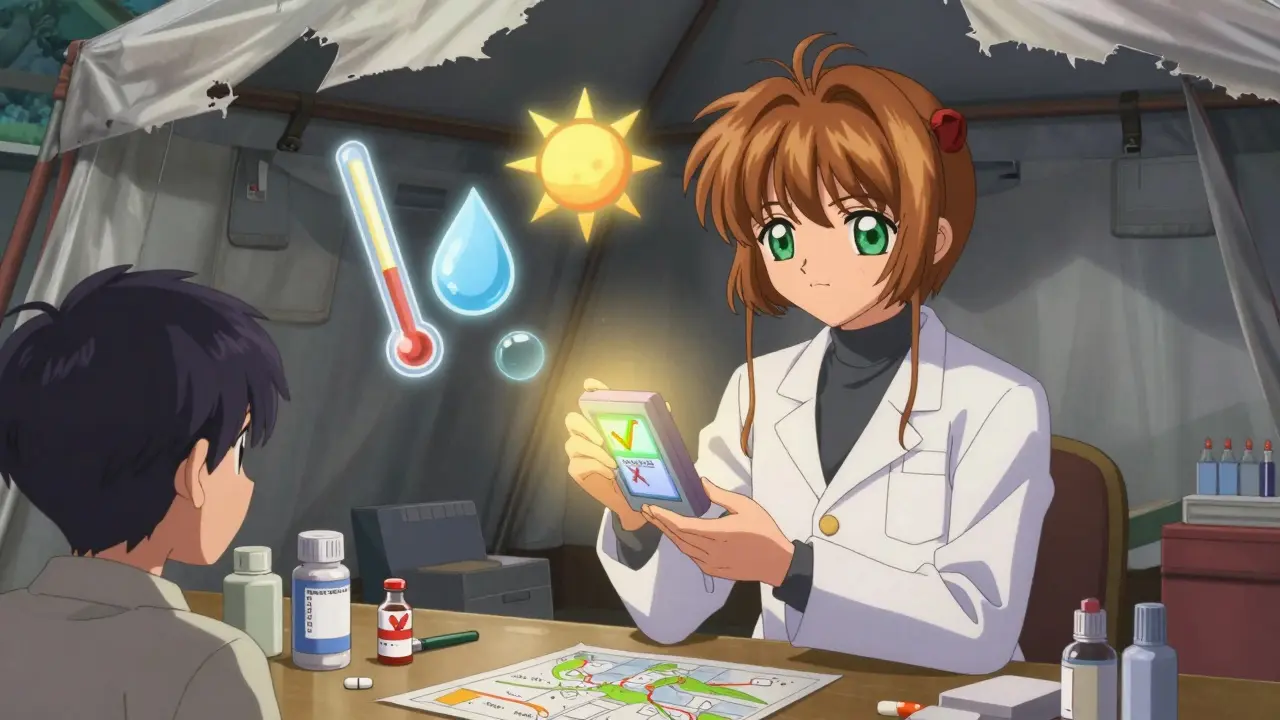
What to Do When There’s No Alternative
The American Pharmacists Association says this clearly: if you have no other option, and your life or health depends on it, using an expired medication is better than doing nothing. But not all meds are equal. Use this quick decision tree:- Is it life-saving? (Insulin, epinephrine, heart meds, seizure drugs) - Use only as a last resort. Know the risks.
- Is it for pain or fever? (Ibuprofen, acetaminophen) - Safe to use even years past expiration.
- Is it for infection? (Antibiotics) - Can be used up to a year past expiration if stored properly. But don’t use if you’re immunocompromised.
- Is it for chronic illness? (Blood thinners, thyroid meds, asthma inhalers) - Avoid if possible. Inconsistent dosing can cause serious harm.
What Experts Really Say
Dr. Sandra Kweder from the FDA put it plainly in a 2023 webinar: “In life-threatening situations with no alternatives, using certain expired medications may be preferable to receiving no treatment at all.” The American Medical Association says antibiotics for serious infections can be used up to a year past expiration - but you may need a higher dose. The American College of Emergency Physicians warns against expired inhalers for asthma attacks after six months. Their data shows failure rates jump dramatically. And here’s something most people don’t know: the FDA has issued Emergency Use Authorizations during disasters like the 2023 Maui wildfires. In those cases, doctors and pharmacists gave specific instructions to patients on how to safely use 6-month-old antibiotics. It wasn’t reckless. It was calculated.Real Stories from Real Disasters
After Hurricane Maria in 2017, 42% of Puerto Ricans used expired meds. Most got relief from pain or headaches. But 22% had treatment failures with chronic conditions like diabetes or hypertension. In California after the 2020 wildfires, 63% of evacuees used expired meds. Those using ibuprofen or acetaminophen reported 89% success. But 37% of people using expired lisinopril saw no drop in blood pressure - and one ended up in the ER. On Reddit’s r/Preppers, a verified pharmacist with the handle PharmD_Emergency wrote: “I’ve seen patients use 6-month expired EpiPens with 60% effectiveness in anaphylaxis - better than nothing, but double the dose if you can.” But there are dark cases too. FEMA reported 12 cases of insulin failure during Texas power outages. Johns Hopkins found 28% of people using expired antibiotics developed resistant infections - compared to just 8% with fresh ones.
What You Can Do Now
Don’t wait for a disaster to figure this out. Prepare now.- Store meds properly: Keep them in a cool, dry place - not the bathroom or car. A drawer in your bedroom is better than a garage.
- Rotate your stock: Use older meds first. Replace them before they expire. Set phone reminders.
- Know your critical meds: Make a list: insulin, epinephrine, heart meds, seizure drugs. These are non-negotiable. Keep extra, unexpired, if you can.
- Know your pharmacy’s emergency rules: In 48 states, pharmacists can give you a 72-hour emergency supply without a new prescription during a declared disaster. Ask your pharmacist now - don’t wait until it’s too late.
- Don’t hoard: Stockpiling too much can lead to expired meds you forget about. Keep a 30-day supply, not a year’s worth.
Rebekah Cobbson
My grandma used expired ibuprofen during the Texas freeze and said it worked fine. I kept thinking she was being reckless until I read this. Turns out she was just smart. Always keep a small stash of painkillers-they’re the safest bet when everything else goes sideways.
Sonal Guha
Expired meds are a luxury rich countries can afford to panic about. In India we use whatever works. If the pill looks intact and the bottle isn’t moldy you take it. No FDA here to babysit your anxiety
TiM Vince
I lived in Puerto Rico after Maria. We used expired insulin. We didn’t have a choice. I saw people give their last vial to someone who needed it more. It wasn’t about science. It was about humanity. The system failed us. We didn’t fail each other.
Jay Powers
Most of us are taught to treat expiration dates like law but they’re more like guidelines with a lot of caveats. I’ve got a 5-year-old bottle of Tylenol in my bug out bag and I’m not worried. Same with aspirin. But epinephrine and insulin? I keep extras and rotate them every six months. Knowledge is the real expiration date you should worry about
Lawrence Jung
You people are so obsessed with safety you forget survival isn’t a spreadsheet. If your life depends on a pill and it’s not expired you’re already dead. The real question is why are you waiting until the disaster to care about your meds at all
Alice Elanora Shepherd
Important note: The FDA’s SLEP data is often misinterpreted. Those were medications stored at 25°C and 60% humidity-ideal conditions. Most homes, especially in humid climates, are not ideal. If your medicine is in a bathroom cabinet or a hot car, assume potency loss is significant. And never, ever use water-damaged pills. Even if they look dry, they’re not safe.
Sona Chandra
THIS IS WHY AMERICA IS BROKEN. You people panic over a date on a bottle while your government lets hospitals run out of insulin. My cousin died because the pharmacy ran out of his blood pressure med after the storm. And now you’re debating whether expired pills are okay? Fix the system. Don’t just teach people how to survive your failures
Cassie Widders
My dad used expired antibiotics during the California fires. Said he felt better. Didn’t get sicker. But he also didn’t take them for more than three days. Just enough to hold on till he got to a clinic. Sometimes the answer isn’t perfect. It’s just enough.
Konika Choudhury
Why are you even talking about this like its a science experiment? In India we dont have expiration dates on most meds. People buy from roadside stalls. They use what they have. If you die from expired medicine maybe you were never meant to live anyway
Darryl Perry
Stop romanticizing expired drugs. The FDA doesn’t lie. If it’s expired, it’s not guaranteed. People die from this. Stop pretending it’s a gray area when it’s not.
Windie Wilson
So let me get this straight. We’re supposed to be grateful that the government is finally testing devices that tell us if our pills still work? After 40 years of ignoring this? Wow. I’m so moved. Next they’ll give us a sticker that says "This might kill you but it’s better than nothing"
Daniel Pate
What’s the ethical line here? If we accept expired meds as a stopgap, are we normalizing systemic failure? Or are we just acknowledging that human survival doesn’t always follow bureaucratic rules? Maybe the real crisis isn’t the expired pill-it’s the fact that we’ve built a society where people have to choose between dying and taking a risk that the system told them was dangerous.