
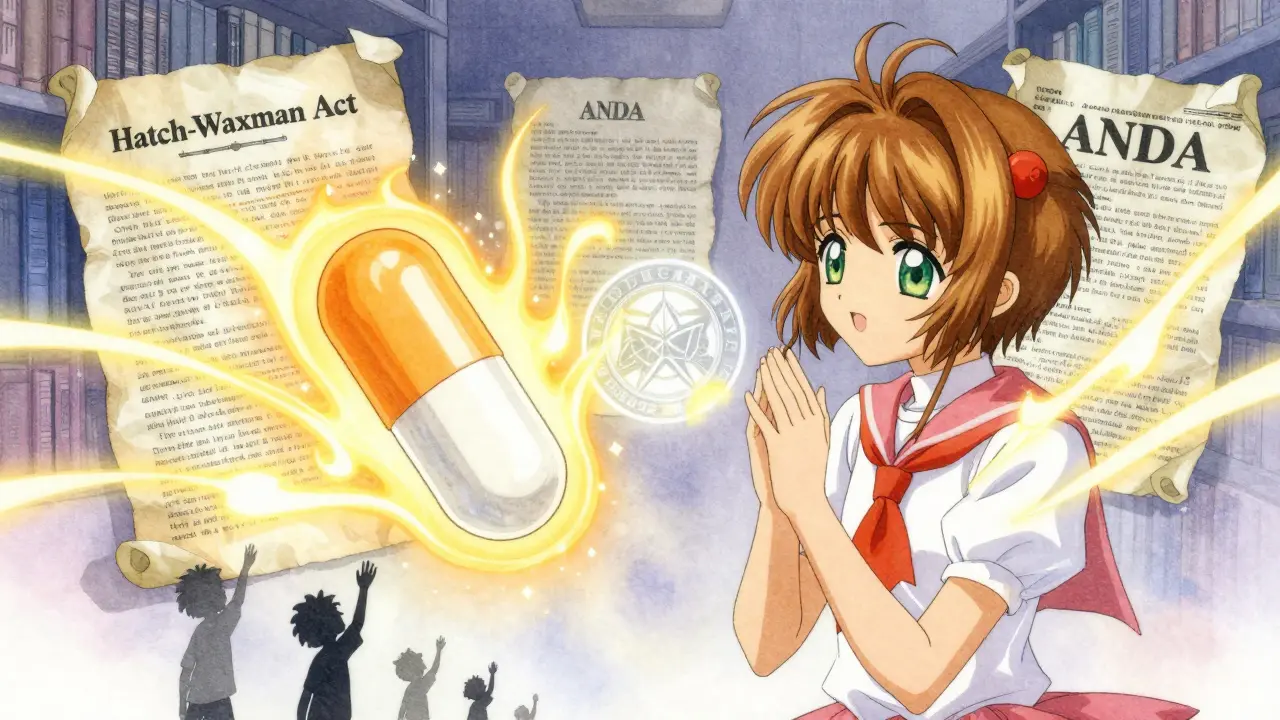
When you pick up a prescription and the pharmacist hands you a pill that looks different from the brand-name version you remember, you’re holding a generic drug - and it’s not a copy. It’s the real thing, legally approved by the FDA to work exactly the same. In fact, 9 out of 10 prescriptions filled in the U.S. today are for generic medications. But how does the FDA make sure these cheaper versions are just as safe and effective as the expensive brand-name drugs? The answer lies in a legal framework created over 40 years ago - the Hatch-Waxman Act - and a streamlined approval process called the Abbreviated New Drug Application, or ANDA.
The Hatch-Waxman Act: The Foundation of Generic Approval
Before 1984, bringing a generic drug to market was nearly impossible. Generic manufacturers had to repeat every clinical trial done by the original drug company, which cost millions and took years. That changed with the passage of the Drug Price Competition and Patent Term Restoration Act of 1984 - better known as the Hatch-Waxman Act. This law, Public Law 98-417, created a new legal pathway for generics under Section 505(j) of the Federal Food, Drug, and Cosmetic Act. Its goal was simple: let safe, effective, lower-cost drugs reach patients faster without compromising quality.
The act struck a balance. It gave brand-name companies extra patent protection to reward innovation, but it also gave generic makers a clear, predictable route to enter the market. The result? Billions in savings for patients and the healthcare system. Today, generic drugs save Americans an estimated $300 billion annually. Without Hatch-Waxman, most of those savings wouldn’t exist.
What the FDA Actually Requires: The ANDA Pathway
The ANDA is the application generic drug makers submit to the FDA. Unlike the full New Drug Application (NDA) required for brand-name drugs - which includes years of clinical trials - an ANDA doesn’t need to prove the drug works from scratch. Instead, it relies on the FDA’s prior findings that the original drug is safe and effective. But that doesn’t mean the FDA cuts corners. The standards are just as strict.
To get approved, a generic drug must match the brand-name drug in four key ways:
- Active ingredient: Same chemical compound, same amount, same purity. No exceptions.
- Strength: If the brand drug is 20 mg, the generic must be 20 mg. No more, no less.
- Dosage form: Same pill, capsule, injection, patch, or inhaler.
- Route of administration: Taken orally? Same as the brand. Injected? Same method.
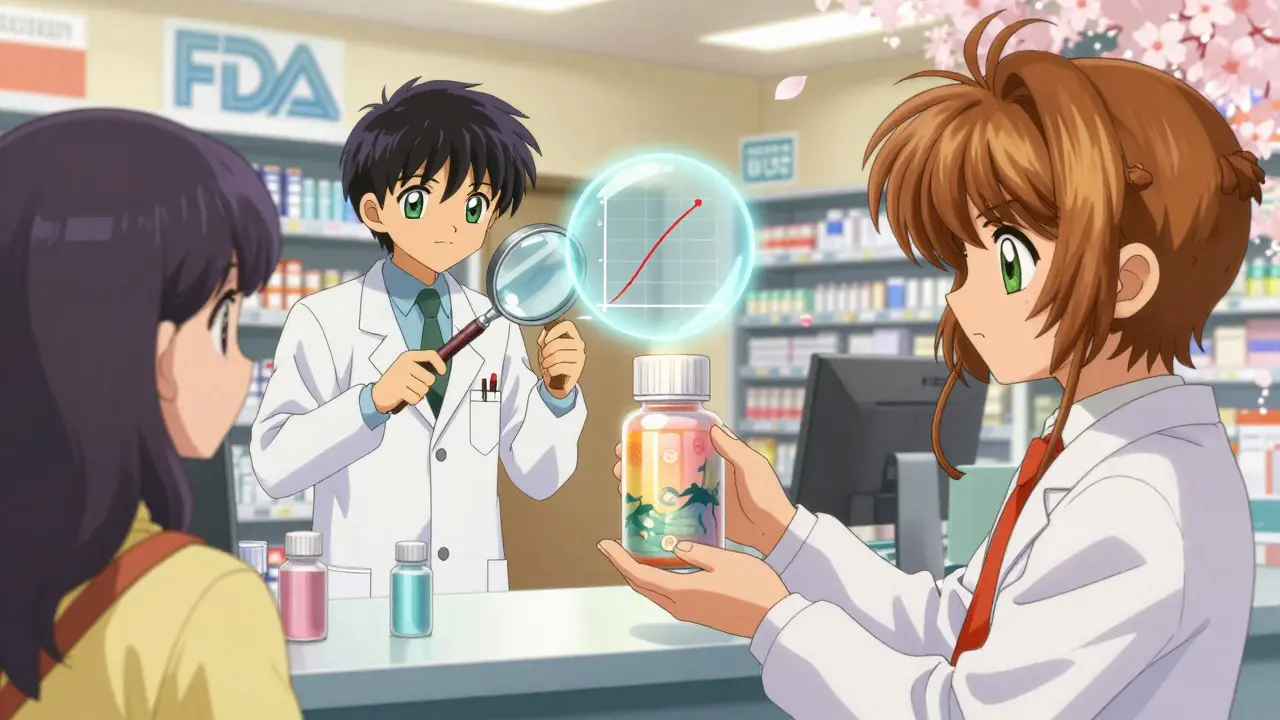
But here’s the most important part: bioequivalence. This isn’t just a buzzword - it’s the scientific heart of generic approval. The FDA requires that the generic drug delivers the same amount of active ingredient into the bloodstream at the same rate as the brand drug. That’s tested in 24 to 36 healthy volunteers using blood tests over several hours. If the generic’s absorption curve falls within 80% to 125% of the brand’s, it’s approved. This range ensures no clinically meaningful difference in how the drug works in the body.
Manufacturing Standards: Same Rules, No Exceptions
It’s not enough for the drug to work the same. It must be made the same way. The FDA requires that generic manufacturers follow the same Good Manufacturing Practices (GMP) as brand-name companies. That means:
- Facilities are inspected regularly - no exceptions.
- Each batch is tested for identity, strength, purity, and quality.
- Production environments are controlled to prevent contamination.
- Labeling must be identical to the brand drug, including warnings and usage instructions.
There’s no special “generic quality” standard. A generic pill made in a factory in India or Iowa must meet the same standard as the brand drug made in New Jersey. The FDA has shut down facilities overseas for failing inspections - even if they were producing a generic version of a common, low-cost drug. Quality isn’t negotiable.
The Approval Timeline: From Submission to Market
Under the Generic Drug User Fee Amendments (GDUFA), the FDA sets clear review goals. For a standard ANDA, the target is 10 months from submission. For priority applications - like first generics or drugs in shortage - it’s 8 months. This is a huge improvement from the pre-GDUFA era, when reviews could drag on for years.
The process starts with a filing review. If the application is missing key data - like bioequivalence studies, manufacturing details, or patent certifications - the FDA issues a Refuse-to-Receive (RTR) letter. The applicant must fix the issues and pay a new fee to resubmit. Many first-time applicants get an RTR. Experienced manufacturers know exactly what the FDA expects.
Once filed, the application enters scientific review. The Office of Generic Drugs (OGD) within the FDA’s Center for Drug Evaluation and Research evaluates every detail. In 2023 alone, the FDA approved 90 first-time generic drugs. Many of these were for high-demand medications like insulin, blood thinners, and mental health treatments.
Patent Challenges and Delays: The Hidden Hurdle
One of the most complex parts of the ANDA process is patent law. Generic manufacturers must certify how they’re handling the brand’s patents. Most choose a Paragraph III certification - meaning they’ll wait until the patent expires. But some choose Paragraph IV: they claim the patent is invalid or won’t be infringed. This is a legal gamble.
If the brand company sues for patent infringement after a Paragraph IV filing, the FDA is legally required to delay approval for 30 months. This “30-month stay” is often used to extend market exclusivity, even when patents are weak. It’s one of the biggest reasons why some generics take years to launch - not because of scientific hurdles, but legal battles.
The FDA’s Drug Competition Action Plan is trying to fix this. It targets drugs with little or no competition, where delays hurt patients the most. In 2023, the FDA approved the first generic of Vivitrol, an injectable treatment for opioid addiction, because it was a critical drug with no alternatives. That approval came after years of delay - a reminder that the system isn’t perfect.
Complex Generics: When Simple Isn’t Simple
The ANDA process works best for pills and injections of small-molecule drugs. But what about inhalers, topical creams, or extended-release tablets? These are called complex generics. They’re harder to copy because small changes in manufacturing - like particle size or coating thickness - can change how the drug works.
The FDA has acknowledged this challenge. In 2025, it launched a pilot program to prioritize ANDA reviews for companies that test and manufacture their products in the U.S. This is part of a broader effort to strengthen domestic supply chains. The agency also runs the Complex Generic Drug Product Development Resources initiative to help manufacturers navigate the science.
For example, a generic version of an asthma inhaler might need clinical trials to prove it delivers the same dose to the lungs as the brand. That’s not bioequivalence - that’s a whole new level of testing. These drugs take longer and cost more to develop, which is why fewer companies enter this space.
Why It Matters: Real Impact on Real People
The numbers tell part of the story. The U.S. generic drug market was worth $125 billion in 2022. Generic drugs cost, on average, 80% to 85% less than brand-name versions. But behind those numbers are real people: a diabetic who can now afford insulin, a veteran who gets their blood pressure pill without skipping doses, a parent who doesn’t have to choose between medicine and groceries.
The FDA’s mission isn’t just regulatory - it’s humanitarian. When a generic drug is approved, it doesn’t just lower prices. It increases access. The agency has explicitly stated that getting generics to market quickly is in the public’s interest. And every time a new generic hits the shelves, it’s a win for patients.
Who Makes These Drugs?
The generic market is dominated by a few big players - Teva, Sandoz, Viatris, and Amneal - but hundreds of smaller companies specialize in niche drugs. Some focus on hard-to-make products like injectables. Others make generics for drugs that have just lost patent protection. The competition is fierce, and it’s what keeps prices low.
Most generics sold in the U.S. are made overseas - especially in India and China. But the FDA inspects those facilities just as rigorously as U.S. plants. In fact, more than half of all inspected manufacturing sites are located outside the U.S. And if a facility fails inspection, the FDA can block imports - even if the drug is already on pharmacy shelves.
What’s Next?
The future of generics isn’t just about more pills. It’s about better access. The FDA continues to refine the ANDA process, reduce review times, and tackle patent abuse. The new U.S.-focused prioritization program announced in October 2025 signals a shift toward domestic manufacturing. And as more complex drugs lose patent protection - like biologics - the FDA is preparing to handle new challenges.
One thing won’t change: the FDA’s commitment to safety. Whether the drug costs $5 or $500, if it’s approved as a generic, it has passed the same rigorous tests. That’s not just policy. It’s science. And for millions of Americans, it’s the difference between getting better - and not getting care at all.
Are generic drugs really as effective as brand-name drugs?
Yes. The FDA requires that generic drugs contain the same active ingredient, strength, dosage form, and route of administration as the brand-name drug. They must also demonstrate bioequivalence - meaning they deliver the same amount of medication into the bloodstream at the same rate. Over 90% of prescriptions in the U.S. are filled with generics, and studies consistently show they work just as well.
Why do generic drugs look different from brand-name drugs?
The active ingredient must be identical, but inactive ingredients - like fillers, dyes, and coatings - can differ. These affect the pill’s color, shape, or taste, but not how the drug works. The FDA allows these differences as long as they don’t impact safety or effectiveness. Some people may react to a specific dye, which is why pharmacists are required to inform you if your prescription changes.
How does the FDA ensure quality of generics made overseas?
The FDA inspects all manufacturing facilities - domestic and foreign - using the same standards. In fact, over half of the facilities inspected are located outside the U.S., mostly in India and China. If a facility fails inspection, the FDA can refuse to approve the drug or block imports. The agency conducts over 1,000 inspections annually, with a focus on high-risk sites.
What is a Paragraph IV certification?
A Paragraph IV certification is when a generic drugmaker claims that a brand-name drug’s patent is invalid or won’t be infringed. This triggers a legal challenge: the brand company can sue, which triggers a 30-month delay in FDA approval. This is often used to extend market exclusivity. While it’s a legal tool, it’s also a major reason some generics take years to reach the market.
Why do some generic drugs take longer to approve than others?
Simple pills and injections are fast to approve. Complex products - like inhalers, patches, or extended-release tablets - require more data, sometimes even clinical trials. The FDA also prioritizes drugs in shortage or those with no competition. If a drug has patent litigation or incomplete submissions, the review can be delayed. Under GDUFA, the target is 10 months, but complex cases can take much longer.
Bryan Woody
So let me get this straight - we're told generics are just as good but then the FDA makes you prove it with blood tests on 36 healthy people? That's not science that's theater. And don't even get me started on the 80-125% bioequivalence window. That's like saying your car's fuel efficiency is fine if it gets between 16 and 25 mpg. I'm not a chemist but even I know that's a wide-ass range. And yet somehow we're supposed to trust this? I've been on generics for 12 years and I swear some of them make me feel like I'm walking through molasses. Not saying they're all bad but the system? It's a joke.
Timothy Olcott
AMERICA FIRST!!! 🇺🇸 Generic drugs made in China? NOPE. FDA says they inspect but how many really get checked? I bet 80% of the pills in my cabinet came from some factory with no running water. I'm done. I'm paying extra for brand names now. No more playing Russian roulette with my health. If it's not made in the USA it's not getting in my body. 🤬
Desiree LaPointe
Oh how quaint. The FDA 'ensures' quality. As if regulatory capture and industry lobbying didn't shape every inch of this 'system.' The Hatch-Waxman Act wasn't a victory for patients - it was a sweetheart deal for Big Pharma to extend monopolies under the guise of competition. And bioequivalence? Please. Two drugs can be 'equivalent' while one has 10% more impurities or a different dissolution profile. The science is a veneer. The real metric is profit margin. I'm not surprised people still believe in the myth of the 'generic equivalent.' It's the American Dream: cheaper but somehow still magical.
Jackie Tucker
It's fascinating how we've turned pharmaceuticals into a utilitarian commodity. We've stripped away the sacredness of medicine - reduced it to chemical equivalence and manufacturing compliance. But what about the human experience? The placebo effect? The ritual of taking a pill? The psychological comfort of a familiar shape or color? We're not machines. We're not algorithms. And yet the FDA treats us like data points on a bioequivalence curve. The real tragedy isn't that generics exist - it's that we've stopped asking whether they're truly enough.
Thomas Jensen
They're lying. You know they're lying. The FDA doesn't inspect every factory. They get paid by the companies they regulate. And those 'generic' pills? Half of them are made in places where the inspectors are bribed. I heard a guy on a forum whose dad died because his generic blood thinner didn't work right. They said it was 'bioequivalent.' Bullshit. It was a death sentence wrapped in a white pill. And now they want us to believe this is safe? I'm not taking another one. Not after this.
Allison Priole
I used to be super skeptical about generics too but after switching to them for my diabetes meds, I actually feel better. Like my energy stabilized. Maybe it was the placebo? Maybe not. Either way, I'm saving $400 a month and I'm not dying. The FDA might not be perfect but they do inspections. And honestly? I'd rather have a cheap pill that works than a fancy one that breaks my bank. We need more of this. Not less. Chill out, folks. It's medicine, not a conspiracy.
Casey Tenney
This system is a fraud. Period.
Sandy Wells
The notion that bioequivalence guarantees therapeutic equivalence is scientifically unsound. The FDA's standards are based on outdated pharmacokinetic models that ignore interpatient variability, metabolic polymorphisms, and formulation dynamics. The approval process prioritizes efficiency over biological nuance. This is not oversight. This is systemic negligence masked as regulation.
Chris Dwyer
Hey I just want to say thank you for writing this. I'm a nurse and I see this every day. People skip doses because they can't afford the brand. Then they end up in the ER. Generics save lives. I've had patients cry because they could finally afford their meds. That's not just economics. That's dignity. The system isn't perfect but it's working for millions. Let's fix the loopholes, not throw the baby out with the bathwater.
matthew runcie
I've been on the same generic for 8 years. No issues. My blood pressure is stable. My doctor says it's fine. My pharmacist says it's fine. The FDA says it's fine. Why am I the one who should doubt it? I'm not a scientist but I trust the process. Maybe that's naive. But I'd rather be naive than broke.
shannon kozee
My mom takes a generic for her thyroid. Last year she switched brands and started having panic attacks. Turns out the filler changed. She's fine now but it took 3 months to figure out. The FDA knows this happens. They just don't talk about it. It's not about the active ingredient. It's about the rest. The invisible stuff. The stuff that makes you feel weird. That's what no one talks about.
trudale hampton
I used to think generics were sketchy until I started working in a pharmacy. I've seen thousands of them. I've seen the inspections. I've seen the paperwork. The FDA is way more strict than people think. The problem isn't the generics. It's that we don't trust anything anymore. We think if it's cheap it's garbage. But sometimes cheap just means efficient. And that's not a bad thing.
Shaun Wakashige
I tried a generic for my anxiety meds. Felt like I was on a different drug. Like my brain got rewired. I went back to brand. Worth every penny. Don't risk it. Life's too short. 🤢
Paul Cuccurullo
The regulatory framework surrounding generic drug approval represents a remarkable achievement in public health policy. By leveraging prior scientific evidence and streamlining administrative procedures, the FDA has enabled unprecedented access to essential therapeutics while maintaining rigorous standards of safety and efficacy. The economic impact alone - over $300 billion in annual savings - underscores the societal value of this model. It is not without imperfection, yet its foundational integrity remains unquestionable.
Solomon Kindie
The whole thing is a loop. Brand companies patent everything even the color of the pill. Then generics file paragraph IV and get sued for 30 months. Meanwhile the brand company just tweaks the formula slightly and files a new patent. Rinse repeat. The FDA doesn't stop this because they're part of it. They're not regulators. They're accountants for Big Pharma. And we're the ones who pay with our health and our wallets. The system isn't broken. It's working exactly as designed.